Curriculum Uses
Curriculum Levels
Benefits
- Online Curriculum for
PreK to 8th Grades
- Access to 3 Grade Levels of Lessons
- 1,000+ Student-Paced Multimedia Activities
- Language Arts, Math, Science & Social Studies
- Interactive, Project-Based Activities
- Detailed Reporting for
Easy Record-Keeping
- Lesson Plans & Teaching Tools for Parents
- Lessons Correlated to State Standards
What Do Parents Say?
I LOVE Time4Learning! It holds the attention of my kids, plus I can keep track of their learning without hovering over their shoulders.
I'm so thankful for your program! My kids have so much fun with the activities that they don't even notice that they're learning!
I am really pleased with Time4Learning. It has made a world of difference in my son's academic performance in school!
|
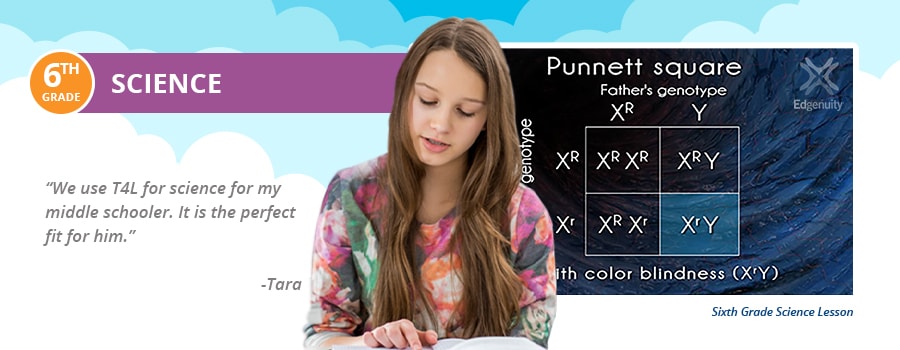
Science -6th Grade Lesson Plans
Time4Learning is an online student-paced learning system covering preschool through middle school. It is popular as a sixth grade homeschool curriculum, for afterschool enrichment, for remediation, and for summer study.
The lesson plans below provide a detailed list of the sixth grade science curriculum, with brief activity descriptions and learning activity (LA) numbers. Additional resources related to sixth grade science are also provided, below.
Sixth is the highest grade level of science activities that Time4Learning offers at this time. Students enrolled in sixth grade science will also have access to fifth grade lessons as part of their membership, so they can review the material.
If you are just learning about Time4Learning, we'd suggest first looking at our interactive lesson demos. Members often use this page as a resource for more detailed planning, to choose specific activities using the activity finder or to compare our curriculum with state standards.
Non-Scored
|
Scored
|
Worksheet
|
Answer Key
|
Quiz
|
| Scientific Discoveries: Demonstrate understanding that scientific knowledge is subject to modification as new information, technology, and discoveries are made. Identify specific scientific discoveries of the past 10 years based on recent data or new technology. |
Science and Technology |
 |
6829 |
  |
| Scientific Discoveries |
 |
6815 |
  |
| Lesson Quiz: Scientific Discoveries |
 |
|
|
| Conduct an Experiment: Design and conduct an experiment using scientific processes; identify the independent, dependent, and constant variables; various instruments used to collect and analyze data; and record-keeping methods. |
Scientific Method |
 |
6817 |
|
| Lesson Quiz: Conduct an Experiment |
 |
|
|
| Variables in an Experiment: Describe how a change in one or more variables can alter the outcome of an experiment. |
Understanding Variables |
 |
6857 |
|
| Lesson Quiz: Variables in an Experiment |
 |
|
|
| Elements in an Investigation: Explain the importance of accurate record keeping, control, and disclosure in the replication of an investigation. |
Keep the Records Straight! |
 |
6821 |
|
| Lesson Quiz: Elements in an Investigation |
 |
|
|
| Collecting & Displaying Data: Use a computer to collect, organize, analyze, and report scientific findings through graphical representation. |
Get Organized! |
 |
6823 |
|
| Lesson Quiz: Collecting & Displaying Data |
 |
|
|
| Safety Procedures: Identify appropriate safety procedures in the home, classroom, and community. |
Safe Science |
 |
6825 |
|
| Lesson Quiz: Safety Procedures |
 |
|
|
| Ethics in Science: Explain the demands of science ethics involving research on human subjects. Explain the ethical treatment of animals involved in scientific research. |
Ethical Science |
 |
6827 |
|
| Lesson Quiz: Ethics in Science |
 |
|
|
| Proving Scientific Experiments: Demonstrate understanding that conclusions are based on scientific evidence obtained from a variety of investigations and sources. Cite several examples of these practices. |
Proving Scientific Ideas |
 |
6831 |
|
| Lesson Quiz: Proving Scientific Experiments |
 |
|
|
| Important Scientists: Identify the accomplishments of the following scientists: Marie Curie, Albert Einstein, Lewis Howard Latimer, and Isaac Newton. |
The Fabulous Four |
 |
6833 |
  |
| Lesson Quiz: Important Scientists |
 |
|
|
| Technology: Describe scientific contributions that have resulted in technological products. Explain the benefits and limitations of electronic information sources. |
Technology and People |
 |
66955 |
|
| Technology: Past and Present |
 |
66956 |
|
| Surfin' USA |
 |
66957 |
|
| The World of the Internet |
 |
66958 |
|
| The Computer Age |
 |
66959 |
|
| Computer Basics |
 |
66960 |
|
| Be an Inventor! |
 |
66961 |
|
| What Inventors Do |
 |
66962 |
|
| Computer Viruses and Vandalism |
 |
66971 |
|
| Protecting Computer Hardware and Software |
 |
66972 |
|
| Lesson Quiz: Technology |
 |
|
|
| Chapter Test: Scientific Process |
|
| Characteristics of Objects: Identify ways in which substances differ (for example, mass, volume, shape, density, texture, light, and reaction to heat). Cite examples of objects that represent these characteristics. |
Stuff |
 |
6836 |
|
| Lesson Quiz: Characteristics of Objects |
 |
|
|
| Different States of Matter: Identify ways in which matter may exist as a solid, liquid, or gas, and cite examples of each. Explain the molecular motion involved when matter changes from solid to liquid to gas. |
Shape-Shifters |
 |
6837 |
|
| Lesson Quiz: Different States of Matter |
 |
|
|
| Elements & Compounds: Identify the differences in properties between elements and compounds as substances. Give an example of each and state which can be separated by physical or chemical means. |
Elementary School |
 |
6841 |
|
| Lesson Quiz: Elements & Compounds |
 |
|
|
| Periodic Table: Use the periodic table to identify the symbols for these elements: oxygen, sodium, copper, carbon, hydrogen, chlorine, aluminum, helium, gold, silver, iron, nitrogen, and silicon. |
Periodic Puzzle |
 |
6845 |
|
| Lesson Quiz: Periodic Table |
 |
|
|
| Mixture & Solution Examples: Identify some substances as mixtures and solutions; for example, paint, cereal, milk, lemonade, soda, and ocean water. |
Breakfast on the Beach |
 |
6849 |
|
| Lesson Quiz: Mixture & Solution Examples |
 |
|
|
| Chapter Test: Properties of Matter |
|
| Scientific Vocabulary: Define the following terms: autotroph, eukaryote, photosynthesis, cellulose, vacuole, chloroplast, and chlorophyll. |
What Makes a Plant a Plant? |
 |
6893 |
|
| Many Plants Can Make Food |
 |
6894 |
  |
| Lesson Quiz: Scientific Vocabulary |
 |
|
|
| Necessities for Plant Survival: Name all the things that plants need to survive successfully on land. |
Plant for a Day |
 |
6895 |
|
| Lesson Quiz: Necessities for Plant Survival |
 |
|
|
| Construct & Label a Plant Cell: Construct a diagram of a plant cell and label the cell wall, cell membrane, chloroplasts, vacuoles, nucleus, and cytoplasm. |
Plant Cell Models |
 |
6897 |
|
| Lesson Quiz: Construct & Label a Plant Cell |
 |
|
|
| Adaptation to Environments: Compare and contrast how plants adapt to their environments: deserts, lakes, jungles, and polar regions. Include such plants as the pasque flower, staghorn fern, bristlecone pine, water lily, barrel cactus, and Venus flytrap. |
The Mystery of Plant Adaptations |
 |
6899 |
|
| Lesson Quiz: Adaptation to Environments |
 |
|
|
| Vascular System: Investigate how a plant''s vascular system works. Predict what will happen when a stalk of celery is placed in a vase with colored water. |
Meet Xylem and Phloem |
 |
6903 |
|
| Lesson Quiz: Vascular System |
 |
|
|
| Photosynthesis: Describe the overall process of photosynthesis. Include the products of photosynthesis. |
Tour a Food Factory |
 |
6905 |
|
| Lesson Quiz: Photosynthesis |
 |
|
|
| Scientific Contributions: Describe the contributions of the following scientists: Joseph Priestley, Jan Baptista van Helmont, Jan Ingenhousz, T. W. Englemann, Julius Sachs, and Melvin Calvin. |
Pieces of the Photosynthetic Puzzle |
 |
6907 |
|
| Lesson Quiz: Scientific Contributions |
 |
|
|
| Structure of a Fern Plant: Describe the structure of a fern plant. Draw a diagram of the plant, and label the structures. |
Ferns, Fronds, and Fiddleheads |
 |
6913 |
|
| Lesson Quiz: Structure of a Fern Plant |
 |
|
|
| Effects of Environments: Compare and contrast the sizes and environments in which nonvascular and vascular plants live. |
They Might Be Plant Giants |
 |
6915 |
|
| Lesson Quiz: Effects of Environments |
 |
|
|
| Seed Plants: Identify the characteristics that seed plants share. Name the main parts of a seed, identify the function of each part, and describe how seeds disperse and germinate. |
The Magic Seeds and the Beanstalk |
 |
6917 |
|
| Lesson Quiz: Seed Plants |
 |
|
|
| Plant Vocabulary: Define the following terms: phloem, xylem, seed, embryo, cotyledon, germination, stomata, transpiration, cambium, and root cap. |
Hip Plant Lingo |
 |
6919 |
|
| Lesson Quiz: Plant Vocabulary |
 |
|
|
| Leaves, Stems, & Roots: Describe the functions of leaves, stems, and roots. |
Plant Forms and Functions |
 |
6921 |
|
| Lesson Quiz: Leaves, Stems, & Roots |
 |
|
|
| Examples of Gymnosperms: Give examples of gymnosperms, and list the characteristics they share. Identify the different environments in which gymnosperms live. Identify four products that are produced from gymnosperms. |
Jim Gymnosperm |
 |
6923 |
|
| Lesson Quiz: Examples of Gymnosperms |
 |
|
|
| Plant Hormones: Identify the following terms: tropism, hormone, and auxin. Identify the functions that plant hormones control. |
Plant Moves |
 |
6929 |
|
| Lesson Quiz: Plant Hormones |
 |
|
|
| Stimulus & Response in Plants: Identify three stimuli that produce plant responses. |
Growing Pains |
 |
6931 |
|
| Lesson Quiz: Stimulus & Response in Plants |
 |
|
|
| Chapter Test: Characteristics of Plants |
|
| Six Forms of Energy: Identify six different forms of energy: mechanical, electrical, chemical, heat, and nuclear. Identify the units that quantify the energy. |
Energy Hunt! |
 |
6853 |
|
| Lesson Quiz: Six Forms of Energy |
 |
|
|
| Sources of Energy: Identify different sources of energy, for example, heat sources and mechanical motion. |
The Source |
 |
6855 |
|
| Lesson Quiz: Sources of Energy |
 |
|
|
| Kinetic & Potential Energy: Explain kinetic and potential energy as states of energy and cite examples of each. |
The Kin & Po Show |
 |
6819 |
|
| Lesson Quiz: Kinetic & Potential Energy |
 |
|
|
| Fossil Fuels: Cite examples of fossil fuels (coal, carbon, oil, and natural gas) as natural resources and the environmental impact of these fuels. |
Save the Nest |
 |
6859 |
|
| Lesson Quiz: Fossil Fuels |
 |
|
|
| Phases of Matter: Identify the properties of different phases of matter and the physical changes involved. Explain how matter can be made to change phases by adding or removing energy. |
State Trooper |
 |
6861 |
|
| Lesson Quiz: Phases of Matter |
 |
|
|
| Water Expansion & Contraction: Explain and illustrate the effects of expansion and contraction on water. |
Ice Water |
 |
6863 |
|
| Lesson Quiz: Water Expansion & Contraction |
 |
|
|
| Changing States of Water: Describe the different processes involved in changing the states of water: condensation, freezing, melting, and boiling. Identify the freezing point and boiling point of water in degrees Celsius and Fahrenheit. |
Set Phasers on Phreeze |
 |
6865 |
|
| Lesson Quiz: Changing States of Water |
 |
|
|
| Force, Motion, & Friction: Describe the relationship between force and motion. Explain the possible effects of two combined forces. Define and explain friction. |
Welcome to Net Force |
 |
6867 |
|
| Lesson Quiz: Force, Motion, & Friction |
 |
|
|
| Measuring Motion: Define how motion is measured in terms of speed, distance, and time. Demonstrate that changes in motion can be graphically represented. |
Speedy McBrainy |
 |
6869 |
|
| Lesson Quiz: Measuring Motion |
 |
|
|
| Laws of Motion: Explain Isaac Newton''s three laws of motion and his law of universal gravitation. Give examples of each law. Investigate these laws by observing, measuring, recording, and reporting results on a graph or chart. |
It's the Law |
 |
6871 |
|
| Lesson Quiz: Laws of Motion |
 |
|
|
| Chapter Test: Energy, Force, & Motion |
|
| Natural Magnetic Mineral: Name a naturally magnetic mineral (magnetite or lodestone), and describe its discovery by the ancient Greeks. |
I, Magnes |
 |
6873 |
|
| Lesson Quiz: Natural Magnetic Mineral |
 |
|
|
| Law of Magnetism: Define magnetism and explain the law of magnetism. Observe, record, and name some objects that are attracted to and that are not attracted to magnets, such as paper, toothpick, paper clip, and wire. |
What's Up with Magnets? |
 |
6875 |
|
| Lesson Quiz: Law of Magnetism |
 |
|
|
| Electromagnetism: Describe how electricity and magnetism are closely related (both involve the motion of electrons). Define electromagnetism and explain how magnetism can be produced from electricity. |
One Cool Word |
 |
6879 |
|
| Lesson Quiz: Electromagnetism |
 |
|
|
| Electromagnets: Explain the structure and operation of electromagnets. Identify some common household objects in which electromagnets are used. Explain the advantages of electromagnets over natural or permanent magnets. |
Turn on Your Magnet |
 |
6881 |
|
| Lesson Quiz: Electromagnets |
 |
|
|
| Construct an Electromagnet: Construct a simple electromagnet. Test the strength of the electromagnet. Describe the materials and procedures; record observations and results of the test. |
Making Mr. Magnet |
 |
6883 |
|
| Lesson Quiz: Construct an Electromagnet |
 |
|
|
| Electrical & Mechanical Energy: Relate electromagnetism to an electric motor. Describe the conversion of electric energy into mechanical energy. |
Motorin' |
 |
6885 |
|
| Lesson Quiz: Electrical & Mechanical Energy |
 |
|
|
| Electricity from Magnetism: Describe the process of producing electricity from magnetism. |
Electromagnetic Abduction |
 |
6887 |
|
| Lesson Quiz: Electricity from Magnetism |
 |
|
|
| Electric Generators: Describe the operation of an electric generator. Identify some ways communities use large generators. |
We Don't Get Many Visitors at the Castle |
 |
6889 |
|
| Lesson Quiz: Electric Generators |
 |
|
|
| Scientific Contributions: Describe the scientific contributions of Hans Christian Oersted, Michael Faraday, and Joseph Henry. |
The Thabulous Three |
 |
6891 |
  |
| Lesson Quiz: Scientific Contributions |
 |
|
|
| Chapter Test: Electricity & Magnetism |
|
| Gravity: Identify and describe the role of gravity as it relates to the Earth, Moon, and Sun. |
Gravity: Revenge of the Wimpy Force |
 |
6935 |
  |
| Lesson Quiz: Gravity |
 |
|
|
| Revolution & Rotation: Distinguish between revolution and rotation. |
Viva la Revolution |
 |
6937 |
|
| Lesson Quiz: Revolution & Rotation |
 |
|
|
| Phases of the Moon: Identify and describe the phases of the Moon. |
Moonlight Sonata |
 |
6939 |
|
| Lesson Quiz: Phases of the Moon |
 |
|
|
| Causes of Day & Night: Identify and describe the causes of day and night. |
The Battle of Daylight |
 |
6941 |
|
| Lesson Quiz: Causes of Day & Night |
 |
|
|
| Solar and Lunar Eclipses: Identify and describe the positions of the Earth, Moon, and Sun during a solar eclipse and a lunar eclipse. |
Block That Sun! |
 |
6947 |
|
| Lesson Quiz: Solar and Lunar Eclipses |
 |
|
|
| Chapter Test: Earth, Moon, & Sun |
|
Scope & Sequence Copyright © CompassLearning, Inc. All rights reserved.
Lesson Activity Finder Tool
The lesson activity finder is one of the many helpful tools that Time4Learning offers its members. The activity finder is a shortcut that makes it easy for parents to preview lessons or find extra practice for their child.
Every lesson in the curriculum has a unique activity number, referred to in the lesson plans as an "LA Number." These numbers can be found on the table above or the lesson plans in the parent administration area.
The activity finder can be found in the lower left hand corner of the Student LaunchPad page. To use it, members simply log in to their child’s account, type the Learning Activity (LA) number of a lesson into the Activity Finder and click “Go” to open it.
For additional information, please visit our hints and help section, which gives more details about the activity finder.
Back to the top or sign up now
Additional Resources Related to Sixth Grade Science
If you're interested in the sixth grade science lesson plans, you might also be interested in:
Wondering how many lessons to have your child do each day? Our lesson planning worksheet can help you estimate.
Online Curriculum for Homeschool, Afterschool and Summer Use
Sign up for Time4Learning and gain access to a variety of educational materials, which will engage and challenge your child to succeed. Make Time4Learning a part of your children's homeschool resources.
I want to Learn More about Time4Learning's homeschool curriculum or how to use the program for afterschool enrichment.
|