Curriculum Uses
Curriculum Levels
Benefits
- Online Curriculum for
PreK to 8th Grades
- Access to 3 Grade Levels of Lessons
- 1,000+ Student-Paced Multimedia Activities
- Language Arts, Math, Science & Social Studies
- Interactive, Project-Based Activities
- Detailed Reporting for
Easy Record-Keeping
- Lesson Plans & Teaching Tools for Parents
- Lessons Correlated to State Standards
What Do Parents Say?
I LOVE Time4Learning! It holds the attention of my kids, plus I can keep track of their learning without hovering over their shoulders.
I'm so thankful for your program! My kids have so much fun with the activities that they don't even notice that they're learning!
I am really pleased with Time4Learning. It has made a world of difference in my son's academic performance in school!
|
Second Grade Overview
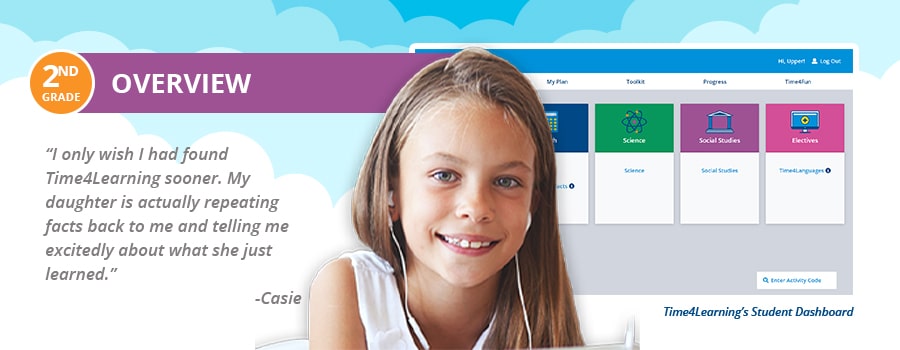
Time4Learning is an online, student-paced learning system covering preschool through middle school. It is popular as a second grade homeschool curriculum, for afterschool enrichment, remediation, or summer study.
For second graders, Time4Learning provides language arts, math, science and social studies. Students also get access to an online playground.
This page provides:
Overview of Second Grade Learning Objectives
This section provides a summary of the key second grade learning objectives for reading, language arts, and math. A more detailed description of each subject is provided below, including links with more information on the hundreds of learning activities. The Time4Learning language arts and math curriculum correlate to state standards.
Second grade is a year of highly visible progress in reading and language arts. The major milestones in second grade reading and language arts are:
- Developing an extensive sight word vocabulary
- Applying more complex phonics strategies
- Writing competently for many purposes
- Using punctuation appropriately
- Experiencing a variety of literary genres
Second grade is also a year of exploration and discovery of the numbers in the world around us. Major milestones for 2nd grade math include:
- Applying numbers sense to the four basic operations
- Understanding the use of money in real life situations
- Developing spatial reasoning in relation to geometric shapes
- Applying the various method s of measurement
- Exploring probability and using data
Below, there is a more in-depth description of the second grade curriculum for language arts, math, science and social studies as well as information about the online playground.
Jump back to the top or sign up now.
My daughter almost had to repeat the 2nd grade, but after a year with with Time4Learning she tested above grade level in math and is at a 5th grade reading level!
Second graders learn to recognize the different letter combinations that create the "a" sound from the Phonics Puppets
Second Grade Language Arts & Reading - Lesson Overview
Second grade language arts is organized into two large sections: Language Arts and Language Arts Extensions.
The language arts section contains 179 learning activities that are primarily based on phonics, fluency, and comprehension. Lessons are taught by colorful animated characters that sing, explain, and interact with the students. Reading and writing exercises within each chapter apply the skills that are taught throughout the chapter. This series constitutes a solid second grade language arts program, correlated to state standards.
One hundred and seventy-nine lessons are organized into nine chapters that introduce and cover:
- Long vowels, punctuation, and story elements - Teaches the long vowel sounds and common vowel digraphs for the vowels e and a. Students learn phonological awareness and reading comprehension through the use of exciting exercises. Second graders will demonstrate a sound knowledge of high frequency words. An interactive story will build fluency, sequencing skills, and the ability to determine the setting of a passage. Writing exercises develop the second grader’s ability to use punctuation correctly.
- Long and r controlled vowels, punctuation, and story elements - Teaches the long vowel sounds and common vowel digraphs using the vowels I and o. Students learn phonological awareness and reading comprehension through exciting exercises. Second graders will demonstrate a sound knowledge of high frequency words. An interactive story will build fluency using question marks, sequencing skills, and the ability to determine the main idea of a passage. Writing exercises give the student the opportunity to apply what has been learned.
- Digraphs, r controlled vowels, punctuation, and story elements - Teaches both vowel and consonant digraphs, special sounds such as “ch”, and r controlled vowels. Students extend phonological awareness, vocabulary, and reading comprehension through the use of exciting exercises. Second graders will demonstrate an extensive knowledge of high fluency words. An interactive story will build fluency using exclamation marks, sequencing skills, and the ability to determine conflict and predict the outcome of a passage. Creative writing experiences enable the student to apply what has been learned.
- Inflectional endings, plurals, and summarizing - Teaches inflectional endings such as “ing” or “ed.” Students extend their knowledge of vocabulary, reading a leveled text, and high frequency words. An interactive story will build fluency using phrasing and commas. The ability to identify the characters and plot, as well as summarize a story is developed. Creative writing experiences enable the student to apply what has been learned.
- Varying consonant use, story elements, writing - Teaches double consonants, vowel exceptions, and silent consonants. Students extend their knowledge of vocabulary, reading a leveled text, and high frequency words. An interactive story will build fluency using phrasing and poetry rhythm. The ability to identify the anticipation, making inferences, and the author’s point of view of a story is developed. Creative writing experiences enable the student to apply what has been learned.
- Antonyms, Synonyms, and Homonyms - Teaches students the proper use of antonyms, synonyms, and homonyms. Students will extend their knowledge of vocabulary, reading a leveled text, locating information in a graph, and high frequency words. Creative writing experiences enable the student to apply what has been learned.
- Suffixes, inferences, and cause and effect - Teaches the use of the suffixes “er”, “est”, and “ly.” Students will extend their knowledge of vocabulary, high frequency words, making inferences, drawing conclusions, and cause and effect. An interactive story will build fluency focusing on stress and tone. Creative writing experiences enable the student to apply what has been learned.
- Prefixes, context clues, and authentic literature - Teaches the use of the prefixes “re” and “un.” Students will extend their knowledge of vocabulary, use of commas and periods, and high frequency words. Fluency is built through the use of phrasing. Students are introduced to reading authentic literature. Creative writing experiences enable the student to apply what has been learned.
- Suffixes, reading maps, and multisyllabic words - Teaches the use of the suffixes “less” and “able”, and reviews prefixes learned. Students will extend their knowledge of vocabulary, reading a leveled text, reading and interpreting maps, summarizing, and cause and effect. Creative writing experience at the end of each chapter enable the student to apply what has been learned.
Click for lesson by lesson details on the Time4learning 2nd grade language arts lesson plans.
Jump back to the top or sign up now.
In second grade language arts, Mother Bird teaches about story details in the reading comprehension lesson "An Astronaut's Life."
In this lesson, students are prompted to
answer questions about details of the story.
Second Grade Language Extensions - Lesson Overview
Language arts extensions is a complete alternative language arts curriculum. It contains 22 chapters made up of 271 activities, 141 worksheets, 44 quizzes and 22 chapter tests.
Many parents have their students work through the language arts section and feel that their children have mastered the materials. Other parents use sections of the language arts extensions for review and reinforcement of specific areas where their children have difficulty. Many parents have their children complete both sections in their entirety.
Each chapter starts with a story that introduces vocabulary, develops reading skills and enhances phonemic awareness. Through a series of learning activities focused on discovery, recognition, and application, second graders will learn to generate ideas, demonstrate comprehension of a theme, create graphic organizers and write a diary entry.
At the end of each chapter, the “Story Creator” teaches second graders to apply their knowledge and use their reading skills to compose grammatically correct sentences and stories.
|
The 22 language arts extensions chapters include:
|
1. Spiders
2. Bees
3. Worms
4. Nutrition
5. Hygiene
6. Fitness
7. Rain Forests
8. Arctic
9. Deserts
10. Directions
11. Maps and Globes |
12. Symbols and Keys
13. Sound
14. Heat
15. Light
16. Hurricanes
17. Tornadoes
18. Volcanoes
19. Conflict Resolution
20. Following the Law
21. Goods and Services
22. Consumers and Producers |
Second Grade Vocabulary
Time4Learning’s second grade vocabulary lessons continue a pattern of vocabulary building by teaching about antonyms, synonyms, and homonyms. Additional second grade vocabulary exercises are presented within 22 thematic units covering insects, rain forests, maps and globes, fitness, and more. Science vocabulary is introduced in units on nutrition, heat, sound, and light.
Second graders improve their reading comprehension by reading or listening to literature with an emphasis on vocabulary. Teacher’s lesson plans include vocabulary lists and optional printable vocabulary worksheets.
For details about second grade writing standards, please visit Time4Writing.com.
Jump back to the top or sign up now.
Part 1 - Background/Story:
- New vocabulary is introduced
- Story is presented in various ways based on skill level
- Activities focus on phonemic awareness & comprehension
- Printable worksheets accompany most activities
- Chapters conclude with Q&A
|
|
Part 2 - Sounds, Letters & Words:
- Alphabetic principles are taught & developed
- New words are reinforced through rhyme and story
- Phonics is taught through discovery and recognition
- Writing skills are developed with "Story Creator"
|
Second Grade Math
The second grade math curriculum contains 120 math lessons, 120 printable worksheets, 91 quizzes and 18 chapter tests. It constitutes a solid second grade math program correlated to state standards.
Animated characters present the second grade math lessons in bite sized pieces, at the student's pace. Each chapter builds on the last. second graders are guided through fractions, order of operations, basic algebra, metrics, spatial sense, graphing and probability using interactive prompts and funny stories to bring the lessons to life.
One hundred lessons are organized into 18 chapters that introduce and cover:
- Number Sense - Second grade "Number Sense" teaches how to read, compare, match, and define whole numbers. Lessons also cover skip counting, odd and even numbers, number line use, and rounding.
- Fractions - Second grade "Fractions" teaches the difference between equal and unequal parts. Fractions divided by halves, thirds, fourths, and eights are introduced in lessons such as "Mangos Take Out", which you can see a screenshot of, below.
- Operations - Second grade "Operations" starts with math vocabulary. It distinguishes the difference between addition and subtraction facts up to 18, and teaches second graders about the associative property. Lessons move into addition and subtraction of one and two digit numbers and gives problem solving strategy using regrouping. This chapter ends with lessons on multiplication, division, and estimation.
- Money - Second grade "Money" teaches about coin values, how to count money, and how to add and subtract it using regrouping.
- Patterns - Second grade "Patterns" teaches students how to identify, sort and classify things by common patterns or attributes. Students learn to identify patterns on a "hundreds chart" and then apply those patterns to skip counting by 2s, 5s, and 10s as well as patterns such as tessellation.
- Algebra - Second grade "Algebra" introduces students to algebraic symbols and the commutative property of addition. Lessons also teach number sentences, equal vs. unequal, greater than vs. less than, real world equations, and solving for unknown numbers.
- Geometry - Second grade "Geometry" teaches about two and three-dimensional shapes. Lessons cover straight vs. curved lines, open vs. closed shapes, and planes vs. solid objects. Students are introduced to similar, congruent, parallel, and perpendicular shapes and asked to compare them in the lessons.
- Positions - Second grade "Positions" introduces basic geometry and spatial relationships. Students learn how to identify, locate and move objects according to directional (left, right, up, down) and positional (top, middle, inside) instruction. Second graders use the coordinate grid as well as the number line to plot and identify numbers.
- Using Shapes - Second grade "Shapes" teaches congruent shapes and symmetry. Students learn to match congruent shapes and identify lines of symmetry in two dimensional shapes. Students are also taught how to identify and create vertical and horizontal lines of symmetry.
- Spatial Sense - Second grade "Spatial Sense" teaches how to build and calculate perimeter and area of two dimensional shapes. It teaches how to recognize geometric shapes and how to use one shape to build another. This chapter also teaches the concepts of perimeter and area.
- Time - Second grade "Time" introduces different ways that time is classified, such as calendar time and clock time. Students learn about digital vs. analog time telling as well as the relationship of hours, days, weeks, and months.
- Length - Second grade "Length" teaches how to use, compare and measure length. Students will choose the appropriate tool and use it to measure different metrics. Students will also apply the measurement skills to measure for perimeter as well as use metric units to determine length.
- Weight - Second grade "Weight" teaches different attributes of weight. Students will estimate, compare and measure with customary and non-customary units of measure.
- Capacity - Second grade "Capacity" teaches how to measure, compare and estimate capacity. It shows students how to identify the best unit and will ask them to place objects in order according to capacity.
- Temperature - Second grade "Temperature" teaches how to measure temperatures. Lessons introduce Fahrenheit and Celsius and show students how to read a thermometer and compare different readings.
- Graphing - Second grade "Graphing" reinforces the "Patterns" chapter by asking students to sort objects. They then learn to create a tally table and record information in pictographs and bar graphs.
- Using Data - Second grade "Using Data" teaches the basics of statistics, showing students how to compare and make predictions based on the data that they organized into graphs.
- Probability - Second grade "Probability" teaches the basics of probability. It teaches the difference between principles of certainty, impossibility, likely and least likely. Second graders are prompted to identify the differences and make predictions based on data.
For a more detailed description of the second grade math lessons, please visit our second grade math scope and sequence page.
Jump back to the top or sign up now.
With Time4Learning, math lessons are taught using colorful activities and easy-to-follow instructions.
In this lesson, 2nd graders learn about different units of measurement by comparing the weight of a watermelon to the weight of a pile of apples.
Second Grade Science
The second grade science curriculum contains 16 lessons and 6 quizzes, organized into 3 chapters:
- Patterns in Nature -Students will learn the steps in the life cycle, the food chain, pond habitat, wetland habitat, and ocean habitat. Lessons will focus on the different characteristics of the different types of animals in each habitat.
- Force and Motion - Students learn about magnetism and the law of magnetic attraction, and apply these to real life objects.
- Earth and Space - Students learn about the objects in our sky, their orbits, and their characteristics.
For a more detailed description of the second grade science lessons, please visit our second grade science scope and sequence page.
Jump back to the top or sign up now.
In second grade science, students learn about life cycles.
In the chapter "Patterns in Nature", the chicken and the
egg example is used to
illustrate a life cycle.
Second Grade Social Studies
The second grade social studies curriculum contains 16 lessons and 6 quizzes, organized into 4 chapters:
- Wants and Needs - Students learn about the basic human needs of food, clothing, and shelter and how these needs are met.
- Earth Science - Students learn about using maps to locate the United States as well as individual states. Map symbols, use of globes, and cardinal directions are taught.
- Contributions to Science - Students learn about historic places, the symbols, icons, buildings, and holidays that represent American beliefs and principles.
- The Surface of the Earth - Students learn about the different types of jobs in the home, school, and community.
For a more detailed description of the second grade social studies lessons, please visit our second grade social studies scope and sequence page.
Jump back to the top or sign up now.
In second grade social studies, Molly and Carlos take a tour of our national treasures.
In the lesson, students are taught about the
historical symbols and buildings from America’s past.
Second Grade Lessons - The Time4Learning Program Structure
Time4Learning has been refined through years of feedback from educators, parents, and students. second grade subjects are organized into chapters composed of interactive lessons, printable worksheets, quizzes and tests. second graders are guided through the activities at their own pace by an automated system.
When students log in, they choose a subject, select a chapter, pick a lesson and complete the activities. A bright green arrow tells them where they left off, and completed work is clearly labeled with a check-mark or a gold star. Visual and auditory prompts guide second graders through the lessons making them easy for young learners to follow, and an online playground (controlled by parents) rewards and motivates them to finish their lessons.
Parents get access to printable lesson plans, teaching tools, detailed reporting and parental support through our online Parent Forum.
Does your child have different achievement levels for math and language arts? No problem. Time4Learning lets you set each individual subject at the appropriate graded level, making this program great for special needs and gifted students.
Jump back to the top or sign up now.
Second Grade Curriculum for Homeschool, Afterschool and Summer Use
Time4Learning can be used for homeschool, afterschool or summer learning and is a great way to start second graders off on the right foot. Time4Learning presents second grade curriculum in a style that is both engaging and effective. Kids love the funny sound effects and quirky cartoon characters delivering the material. Animated, interactive lessons feel more like video games than learning exercises. Plus, the student-paced nature of the program teaches them how to work independently, giving them a sense of ownership over their progress, which is a great motivator.
Time4Learning is entirely web based, so there is no software to download, no CDs and nothing additional to purchase. Your kids will be able to access the program 24/7 from any computer with an internet connection. It has a low monthly price, requires no contracts and offers a 14 day money-back guarantee.
Time4Learning has helped thousands of families. Why not yours? – Sign up now.
|