Curriculum Uses
Curriculum Levels
Benefits
- Online Curriculum for
PreK to 8th Grades
- Access to 3 Grade Levels of Lessons
- 1,000+ Student-Paced Multimedia Activities
- Language Arts, Math, Science & Social Studies
- Interactive, Project-Based Activities
- Detailed Reporting for
Easy Record-Keeping
- Lesson Plans & Teaching Tools for Parents
- Lessons Correlated to State Standards
What Do
Parents Say?
I LOVE Time4Learning!
It holds the attention of my kids, plus I can keep track of their learning without hovering over their shoulders.
I'm so thankful for your program!
My kids have so much fun with the activities that they don't even notice that they're learning!
I am really pleased with Time4Learning. It has made a world of difference in my son's academic performance in school!
|
Fourth Grade Overview
Time4Learning is an online, student-paced learning system covering preschool through middle school. It is popular as a fourth grade homeschool curriculum, for afterschool enrichment, remediation, or summer study.
For fourth graders, Time4Learning provides language arts, math, science and social studies. Students also get access to a parent-controlled online playground.
This page provides:
Overview of Fourth Grade Learning Objectives
This section provides a summary of the key fourth grade learning objectives for reading, language arts, and math. A more detailed description of each subject is provided below, including links with more information on the hundreds of learning activities. The fourth grade language arts and math curriculum correlate to state standards.
Fourth grade is a year of highly visible progress in reading, writing and language arts. By the end of fourth grade language arts, students should be able to:
- Read with a higher level of fluency and expression
- Utilize root words, prefixes, suffixes, and context clues to analyze unfamiliar words
- Apply comprehension strategies to literary and expository texts
- Formulate multiple paragraph pieces that focus on a specific purpose or audience
- Write chronological pieces, pieces focusing on cause and effect and pieces that draw from personal experience
Fourth grade is also a year of visible math skill development. By the end of fourth grade math, students should be able to:
- Add and subtract large numbers with sums up to 1,000,000
- Complete basic multiplication and division problems
- Understand basic fraction and decimal concepts
- Recognize and identify basic geometrical vocabulary and ideas
- Be proficient in data collection and analysis
Below, there is a more in-depth description of the fourth grade curriculum for language arts, math, science and social studies as well as information about the online playground.
Jump back to the top or sign up now.
It's amazing how quickly my kids are learning difficult concepts on the Time4Learning program. The animation really helps them apply the lessons to something tangible!
As part of fourth grade language arts,
students are asked to identify
the suffix of a word
Fourth Grade Language Arts - Lesson Overview
Fourth grade language arts is organized into two large sections: Language Arts and Language Arts Extensions.
The language arts section contains 112 learning activities, 35 worksheets, and 8 teaching materials that are primarily based on reading comprehension, writing skills and vocabulary. Independent learning activities (ILA) think alouds, interactive guided instruction and read & respond lessons will build and develop working knowledge of language arts skills and give them plenty of practice. This series constitutes a solid fourth grade language arts program, correlated to state standards.
One hundred and twelve lessons are organized into eleven chapters that introduce and cover
- Vocabulary Skills - Synonyms, antonyms, homonyms and idioms are taught with new vocabulary using reading activities that build fluency. Lessons build a working understanding of suffixes, prefixes, and reading skills. Students are asked to identify, interpret and analyze passages.
- Process Skills: Think Alouds - Teaches the reading comprehension process of summarizing, predicting, visualizing, questioning, and clarifying with extensive scaffolding and support, through think aloud prompts.
- Comprehension - Teaches comprehension strategies to literary and expository texts. Fourth graders learn to identify and write about the characters, setting, plot, main idea and supporting details of a story. They learn about sequential order, fact and opinion, cause and effect, author’s purpose, inferences, and comparing and contrasting story elements.
- State Simulation Assessments - Mock assessment that uses simulated questions to teach students how to apply reading comprehension skills to high stakes tests. Students are asked to display working knowledge based on appropriate reading material.
- Pioneers (ILA) - Independent Learning Activity (ILA) that builds vocabulary and comprehension skills. Fourth graders will read an authentic narrative about life on the frontier. They will be asked to describe the setting, analyze the story and then write their own interpretation.
- Mystery (ILA) - A series of activities that uses fictional literature from the mystery genre to develop reading, writing and thinking skills. While solving a mystery, students will learn about inferences, quotations, paragraph forms and new vocabulary. They will also be asked to analyze clues and write a mystery report on their findings.
- Natural Disasters (ILA) - Teaches about natural disasters. A series of activities that develop and practice reading, writing, and thinking skills. Students will first read a nonfiction story. Then, they will follow guidelines on punctuation and sentence combination to compare and contrast elements of the story.
- African American Poetry (ILA) - Teaches vocabulary, reading comprehension, writing, and thinking skills using authentic African American poetry. Activities combine direct instruction with read & responds to teach about root words, suffixes, prefixes, metaphors and inferences. Students are asked to write about their opinions.
- Heroes (ILA) - Develops vocabulary, reading, writing, and thinking skills using literature that revolves around heroes. Fourth graders are asked to describe a special event , draw conclusions about story characters and write a news article about a hero.
- Inventory and Inventions (ILA) - Teaches vocabulary, reading comprehension, writing, and thinking skills using a theme about inventions. Activities combine direct instruction with read & responds to teach about cause and effect, contractions, quoting and paraphrasing. Students are asked to write about a character's actions.
- Famous Americans (ILA) - Teaches vocabulary, reading comprehension, writing, and thinking skills using authentic nonfiction by Franklin D. Roosevelt. Activities combine direct instruction with read & responds to teach about summarizing and sentence fragments. Vocabulary is emphasized in word analysis lessons, and students are asked to write an expository essay about FDR at the end of the chapter.
Click for lesson by lesson details on the Time4learning 4th grade language arts lesson plans.
Fourth Grade Reading List
Many parents have expressed interest in purchasing the full versions of the authentic literature excerpted in the fourth grade language arts section. They can be purchased at the links below but they DO NOT need to be purchased in order to use Time4Learning.
Jump back to the top or sign up now.
In fourth grade language arts, Jose and Jenae learn how to solve a mystery in the Mysterious Missing Ball
In this lesson, students are asked to solve a mystery using observation skills and clues.
Fourth Grade Language Extensions - Lesson Overview
Language arts extensions contains 5 chapters made up of 114 activities, 54 quizzes and 2 worksheets.
Language arts extensions is a complete alternative language arts curriculum and covers vocabulary, grammar, spelling, poetry, punctuation, and writing. Many parents have their child complete both the language arts and language arts extensions. Others use language arts extensions for review, additional practice or reinforcement. Members have access to both, so they can use the exercises in the way that best fits their needs.
One hundred and fourteen lessons are organized into five chapters that introduce and cover:
- Comprehend & Respond - Students learn to use a variety of strategies to comprehend and respond to a variety of different texts. Lessons include using facts, fiction, or opinion, developing dictionary competency, and extensive grade level appropriate vocabulary.
- Grammar - Students learn to apply what they have learned about grammar and mechanics as they write original compositions. Lessons focus on parts of speech, similes and metaphors, punctuation, double negatives, and spelling rules.
- Literature - Students learn to respond and comprehend a variety of literature including fiction, nonfiction, biography, poetry folklore, and public documents. Lessons include a focus on the elements, style, and characteristics of the various literary genres.
- Written Communication - Students learn to communicate ideas and information through creative writing for a variety of purposes such as: informing, persuading, influencing, responding, and creating. Lessons include the Writing Process, personal experience writing, and research.
- Convention of Language - Students will learn the various conventions of language to aid in communicating ideas orally. Lessons will focus on developing the student’s active listening and critical thinking skills in order to enhance understanding. Students learn about oral expressions, diverse vocabulary effective speaking, and listening skills.
Fourth Grade Vocabulary
Vocabulary building strategies are emphasized throughout Time4Learning’s fourth grade language arts program. Vocabulary exercises encourage students to identify prefixes and suffixes, using this information to determine the correct meaning of a word. Animated vocabulary lessons cover synonyms, antonyms, and homonyms.
Literature-based study of topics such as pioneers, natural disasters, African American poetry, and inventors present themed vocabulary words. Ten concentrated units offer traditional vocabulary lists. Math vocabulary is introduced with vocabulary words relating to quantity and size. Units culminate with a vocabulary test to assess understanding.
For details about fourth grade writing standards, please visit Time4Writing.com.
Jump back to the top or sign up now.
In fourth grade language arts extensions, students learn about literary genres in the lesson Fables
In this lesson, students are asked to
read a short excerpt about fables and answer questions.
Fourth Grade Math
The fourth grade math curriculum contains 259 math lessons, 119 printable worksheets, 81 quizzes and 18 chapter tests. It constitutes a solid fourth grade math program correlated to state standards.
Animated characters present the fourth grade math lessons one step at a time, at the student's pace. Lessons build on the skills they learned in third grade, as fourth graders are guided through fractions, decimals, geometry, algebra, measurement, and probability using interactive prompts and conceptual explanations.
Two hundred fifty-nine lessons are organized into seventeen chapters that introduce and cover:
- Number Theory and Systems - Teaches how to write numbers up to nine digits, number comparison, standard and expanded form of numbers, and rounding numbers.
- Addition and Subtraction - Teaches the computation of numbers up to four digits. Lessons also include estimating sums and differences while rounding numbers.
- Multiplication and Division - Starts with math tutorials. It distinguishes the key components of multiplying several digits and introduces partial products. Lessons also include several practice scenarios for applying what students have learned with multiple digit multiplication. Division with 2 digit divisors is taught in conjunction with averaging numbers.
- Fractions and Decimals - Teaches relationships between numbers and the various ways of representing fractions and decimals. Lessons include adding and subtracting fractions and decimals.
- Money - Teaches students how money matters, how to count and make change, using decimals with money, and multiplying and dividing money.
- Patterns - Introduces students to pictorial and numeric patterns. Students explore function at the end of the chapter.
- Algebra - Teaches about addition and subtraction with variables. Lessons cover the associative and commutative properties.
- Properties of Shapes - Introduces basic geometry and spatial relationships. Students learn how to identify line segments, rays, lines, angles, polygons, and circles.
- Coordinate Geometry - Teaches ordered pairs, navigational directions, and distance with the coordinate plane.
- Transformations and Symmetry - Teaches congruence, similarity, transformations, symmetry, and the classification of each.
- Time - Introduces different ways that time is classified, such as calendar time and clock time. Lessons also teach how to tell time to the 1 and 5 minute intervals, finding elapsed time, and interpreting time schedules.
- Customary System - Teaches the students how to use the customary systems of measurement to understand the attributes of length, weight, capacity, and temperature and how to apply appropriate measuring techniques. Lessons also cover conversion of measurements.
- Metric System - Teaches the units of metric measurement and how to convert them.
- Perimeter, Area & Volume - Teaches how to find perimeter, area, and volume through customary and non customary methods of measurement. Lessons also introduce volume.
- Display and Interpret Data - Teaches students to recognize data in the form of frequency tables, bar graphs, line graphs, and stem and leaf plots. Students are also taught the different types of statistical measurements such as mean, median, mode, and range.
- Probability - Teaches reinforces the ideas of certainty and likelihood, combinations, and probability. Students are taught how to calculate probability as a fraction.
- Problem Solving - Teaches the basics of problem solving using diagrams, charts, lists, and addition and subtraction of equations to solve word problems.
For a more detailed description of the fourth grade math lessons, please visit our fourth grade math scope and sequence page.
Jump back to the top or sign up now.
In fourth grade math, Frank learns about the different ways fractions can be
represented in the lesson Part of the Pie
Here at Frank's Fraction Pizzeria,
4th graders learn about the relationships
between numbers, decimals and fractions.
Fourth Grade Science
The fourth grade science curriculum contains 133 lessons, 7 worksheets and 66 quizzes, organized into 9 chapters:
- Scientific Investigation - Lessons will focus on reasoning strategies as students are asked to conduct a simple experiment by asking a scientific question, stating a hypothesis, listing the procedure, recording the results, and communicating the conclusion. They will learn how to display data using graphs, tables, drawings, and other media.
- Changes in Matter and Energy - Students will learn about the basic properties of matter and their physical and chemical changes. They will learn how to classify matter, measure heat, describe physical and chemical changes, distinguish between types of change and apply force to an object.
- Sound - Students will learn the basic principles of sound, identify the basic physical phenomena of sound and learn how to identify musical instruments that create it.
- Solar System and the Universe - Students learn about the structure of the solar system and the universe. They are taught about the composition and formation of rocks and soil. They learn about the arrangement and movements of planets, meteors, comets and the sun. They are asked to classify each according to size, characteristics, and composition.
- Living Things - Students learn about the characteristics, structures, and functions of living things and of how living things interact with one another and their environment. They will learn the difference between vertebrates, invertebrates, ecosystems and the basic requirements of life. Students learn about environmental impact and the protection of natural resources.
For a more detailed description of the fourth grade science lessons, please visit our fourth grade science scope and sequence page.
Jump back to the top or sign up now.
In fourth grade science, Lucas learns about digestion in the lesson Digestion: Step by Step
In this lesson, students are asked to
respond to questions about what each system
in the body is responsible for
Fourth Grade Social Studies
The fourth grade social studies curriculum contains 107 lessons, 6 worksheets and 63 quizzes, organized into 9 chapters:
- Ancient Civilization - Teaches about the ancient civilizations of Mesopotamia, Egypt, and the Indus Valley. Students learn about both Mesopotamian and Egyptian geography, culture, architecture and government.
- Aztecs, Incas, and Mayas - Teaches
- U. S. Revolutionary Period - Students
- Geography - Teaches
- United States Civics - Teaches
- Economics - Students
- Current Events - Students
- Prehistoric Art - Students
For a more detailed description of the fourth grade social studies lessons, please visit our fourth grade social studies scope and sequence page.
Jump back to the top or sign up now.
In fourth grade social studies, students
learn about making maps in the lesson
Finding Your Place in the World
In this lesson, students are asked to
apply what they have learned by drawing
their own map with a key and symbols
Fourth Grade Lessons - The Time4Learning Program Structure
Time4Learning has been refined through years of feedback from educators, parents, and students. fourth grade subjects are organized into chapters composed of interactive lessons, printable worksheets, quizzes and tests. fourth graders are guided through the activities at their own pace by an automated system.
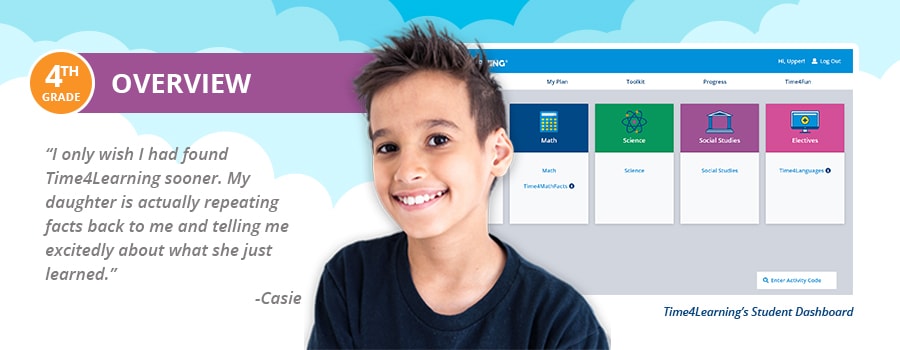
When students log in, they choose a subject, select a chapter, pick a lesson and complete the activities. A bright green arrow tells them where they left off, and completed work is clearly labeled with a check-mark or a gold star. Visual and auditory prompts guide fourth graders through the lessons making them easy for young learners to follow, and an online playground (controlled by parents) rewards and motivates them to finish their lessons.
Parents get access to printable lesson plans, teaching tools, detailed reporting and parental support through our online Parent Forum.
Does your child have different achievement levels for math and language arts? No problem. Time4Learning lets you set each individual subject at the appropriate graded level, making this program great for special needs and gifted students.
Jump back to the top or sign up now.
Fourth Grade Curriculum for Homeschool, Afterschool and Summer Use
Time4Learning can be used for homeschool, afterschool or summer learning and is a great way to start fourth graders off on the right foot. Time4Learning presents fourth grade curriculum in a style that is both engaging and effective. Kids love the funny sound effects and quirky cartoon characters delivering the material. Animated, interactive lessons feel more like video games than learning exercises. Plus, the student-paced nature of the program teaches them how to work independently, giving them a sense of ownership over their progress, which is a great motivator.
Time4Learning is entirely web based, so there is no software to download, no CDs and nothing additional to purchase. Your kids will be able to access the program 24/7 from any computer with an internet connection. It has a low monthly price, requires no contracts and offers a 14 day money-back guarantee.
Time4Learning has helped thousands of families. Why not yours? – Sign up now. |