Kindergarten Spelling Word Lists & Curriculum
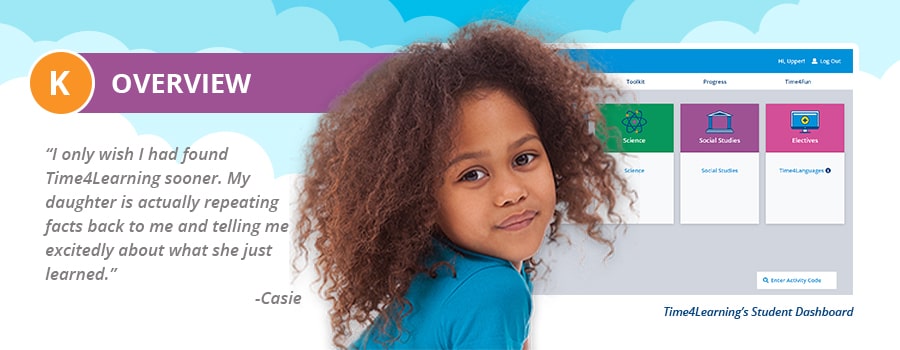
Time4Learning is an online student-paced learning system popular as a kindergarten homeschool curriculum, as an after school tutorial and skill sharpening during the summer break.
This page is a summary of curriculum topics, foundational skills and resources related to kindergarten spelling including information about:
- Kindergarten Spelling Curriculum
- Foundational Spelling Skills
- Kindergarten Spelling Words List
- Kindergarten Spelling Resources
- Additional Helpful Parent Tools & Resources




Kindergarten Spelling Curriculum Sequence
The spelling curriculum for kindergarten should cover kindergarten spelling words start with basic two letter words, or three letter consonant-vowel-consonant words, and become more complex.
For example, spelling words can be introduced that end with a silent e, changing the first vowel from short to long, for example, with a silent-e, HOP changes to HOPE. Also the double-e sound as in SEE, FEE and TREE and double-o as in BOOK are introduced.
Another starting point for kindergarten spelling lists for the start of the year are: DAD and MOM. Children then start to expand the list by working through “word families”. From DAD, students would then learn that changing the first letter of a word would change the meaning and sound like BAD, SAD, HAD, and MAD. Also, they will learn that changing the vowel will also change the word like DID and HID.
In kindergarten, spelling skills grow to cover blends, for example, T plus R make the TR sound, such as in TREE. F and R blend to make the FR sound in FROG.
These very young children learn through spelling activities including many creative methods that make the kindergarten spelling program fun for them. Remember, every child learns at a different rate, so what works for some students, may not be the correct approach for your child. Which is why so many parents enjoy Time4Learning’s self-paced, modularized lesson plans. You can skip lessons that teach concepts your child has already mastered and repeat those he or she has not. The choice is yours.
Foundational Spelling Skills
Spelling skills should develop as part of an overall language arts phonemic awareness, phonics, reading comprehension, vocabulary and reading fluency, grammar, reading and writing program. Children should (with help from their parents) develop their foundational spelling skills through an interest in words, regular writing, constant reading, a study of spelling rules, and playing of spelling games.
With help from their parents, children can develop and reinforce foundational spelling skills through the following activities:
- Regular writing for a head start on spelling, punctuation, and other concepts
- Constant reading or use of reading workbooks
- Frequent study of spelling rules like the relationships between letters and sounds
- Spelling bees for a fun way for your child to practice their spelling
- Playing of spelling games, quizzes or word games to help develop their spelling skills
- Structured computer spelling programs
- Personalized tutoring and assistance to boost confidence
- Setting daily blocks of time for spelling and reading activities
- Instruction through guided spelling activities like word sorts or word boxes
- Creating a rich language environment at home based on the quantity and quality of words spoken
Time4Learning teaches a comprehensive kindergarten spelling curriculum using fun activities to build a solid spelling foundation. Help your child excel in spelling by trying out one of our Time4Learning’s kindergarten demos.
Kindergarten Spelling Words List
What spelling words should your kindergartener know? Here is a list of 40+ words that are great for use in spelling games, tests, or practice for an upcoming spelling bee. To add more value, download our Kindergarten spelling list printable worksheet with + 50words!
- bay
- day
- hay
- may
- pay
- ray
- say
- way
- fray
- gray
- by
- cry
- dry
- fry
- try
- toe
- hoe
- paw
- raw
- saw
- well
- book
- cook
- took
- bold
- cold
- fold
- hold
- mold
- sold
- doll
- game
- toy
- train
- get
- got
- say
- said
- car
- bus
Kindergarten Spelling Resources
If you’re interested in kindergarten spelling lists or vocabulary words, you might also be interested in:
- Our lesson planning worksheet can help you estimate how many lessons to have your child do each day
- Kindergarten curriculum overview with a summary of key kindergarten learning objectives
- Detailed list of Kindergarten language arts lesson plans
- Kindergarten Reading comprehension practice activities
Additional Parent Tools & Resources
Welcome to Homeschooling Guide – Are you new to homeschooling? This guide was written by seasoned homeschoolers to answer some of the difficult questions new families often struggle with.
Curriculum Lesson Plans – An overview of the number of lessons that are included for each grade and subject. All students have access to at least 2 (and in most cases 3) grade levels of curriculum for each subject, so they can move ahead or review at their own pace.
Lesson Planning Worksheet – Wondering how many lessons to have your child do each day? Estimate the number of activities per day using this easy to use, printable worksheet.