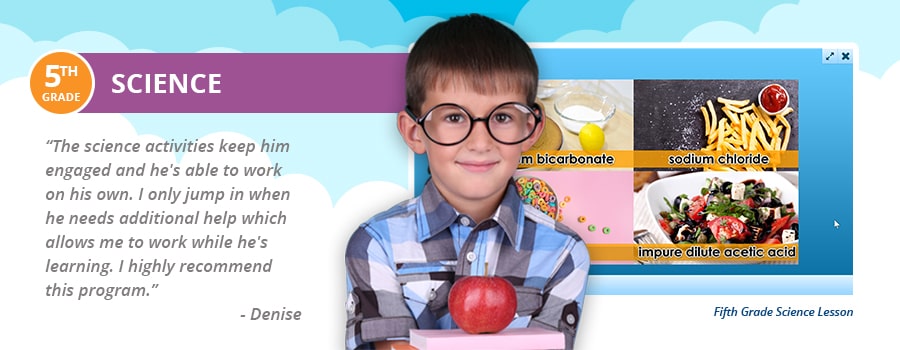
Time4Learning's educational content is provided primarily by CompassLearning Odyssey®.
Chapter -"Scientific Investigation"-The learner will demonstrate competency in the process of completing scientific investigations.
|
1
|
Identify the Problem-Identify problems
that can be solved by conducting experiments.
|
5644, 5645
|
2
|
Plan the Experiment-Create a written
plan for an experiment.
|
5646 5647
|
3
|
Conduct Scientific Experiments-Design
and conduct a scientific experiment within the generally accepted
rules and ethics of science.
|
5648 5649
|
4
|
Collect & Organize Data-Collect and organize
data to support the result of an experiment.
|
5650 5651
|
5
|
Record Observations-Keep records of observations
during an experiment.
|
5652 5653
|
6
|
Unexpected Findings-Explain that scientific
experiments sometimes result in unexpected findings that lead
to new questions and more experiments.
|
5580 5654 5655
|
7
|
Control Groups in Experiments-Design
and conduct an experiment incorporating the use of a control
group.
|
5656 5657
|
8
|
Time Line of Scientific Events-Develop
a time line of major events and people in the history of science,
that also include major world events in other fields.
|
5658 5659
|
Chapter -"Changes in Matter"-The learner will demonstrate knowledge of how changes in matter are related to atoms and molecules.
|
1
|
Structural Components of Atoms-Identify
electrons, protons, and neutrons as basic structural components
of atoms.
|
5660 5661
|
2
|
Construction of Matter-Know that all
matter is made up of atoms that may join together to form
molecules and compounds, and that the state of matter is determined
by the motion of molecules.
|
5662 5663
|
3
|
Elements-Know that elements have atoms
of only one kind, and recognize that elements can be organized
in a systematic way.
|
5664 5665
|
4
|
Periodic Table-Be able to read and understand
some of the periodic table: elements can be identified by
symbols, the table can be read across from left to right and
from top to bottom, atomic numbers tell how many protons are
in each atom, the table is divided into metals and nonmetals,
elements on opposite sides of the table easily react with
each other to form compounds.
|
5666 5667
|
Chapter -"Electricity and Matter"-The learner will examine how electricity interacts with matter.
|
1
|
Characteristics of Electricity-Identify
electricity as the flow of electrons: positive pole (terminal),
negative pole (terminal).
|
5668 5669
|
2
|
Unit of Electrical Force-Know that the
force that makes electrons flow is called voltage and that
the unit of electrical force, or push, is called the volt.
Define: alternating current (AC), direct current (DC), alternator.
|
5670 5671
|
3
|
Electrical Measurement-Know how electricity
is measured: volts, amps (amperage), ohms, Ohm's law: volts
= amps x ohms.
|
5672 5673
|
4
|
Electric Power-Know how electric power
is measured: watts (wattage), volt x amp = watt.
|
5687 5688
|
5
|
Conductors & Insulators-Know the difference
between conductors and insulators.
|
5675 5676
|
6
|
Structure of Circuits-Know the structure
of simple electrical circuits: closed circuit, open circuit,
short circuit.
|
5677 5678
|
7
|
Series & Parallel Circuits-Demonstrate
principles of series and parallel electrical circuits.
|
5679
|
8
|
Electrical Resistance & Ohms-Demonstrate
electrical resistance and understand the use of ohms.
|
5681
|
9
|
Electrical Safety-Learn about electrical
safety.
|
5683 5684
|
10
|
Michael Faraday-Describe the scientific
contribution of Michael Faraday.
|
5685 5686
|
11
|
Thomas Edison-Describe the scientific
contribution of Thomas Edison.
|
5674
|
Chapter -"Light"-The learner will demonstrate understanding of the basic characteristics of light.
|
1
|
Light as Energy-Know that light is a
form of energy, and that the speed of light is 186,000 miles
per second.
|
5689 5690
|
2
|
Characteristics of White Light-Describe
the basic characteristics of white light: visible spectrum,
light waves, reflection, refraction.
|
5691 5692
|
3
|
Opaque/Transparent/Translucent-Describe
the basic characteristics of white light: opacity, transparency,
translucence.
|
5693 5694
|
4
|
Light Measurement-Know how light is measured:
wavelengths, frequency, cycle.
|
5695 5696
|
5
|
Light Interaction with Matter-Show how
light is reflected, refracted, or absorbed when it interacts
with matter and how colors appear as a result of this interaction.
|
5697
|
6
|
Reflections of Light-Describe the use
and basic design of kaleidoscopes, flashlights, and mirrors.
|
5540 5699
|
7
|
Refractions of Light-Describe the use
and basic design of eyeglasses, prisms, and cameras.
|
5541 5542
|
8
|
Optics & Magnifiers of Light-Describe
the use and basic design of binoculars, microscopes, and telescopes.
|
5543 5544
|
9
|
Lasers & Photocopiers-Describe the use
and basic design of lasers, and photocopiers.
|
5545 5546
|
Chapter -"Organisms"-The learner will demonstrate an understanding that organisms are made up of cells and will explain how cells grow, develop, and reproduce.
|
1
|
The Smallest Unit of Life-Identify the
cell as the basic unit of life and the smallest unit that
can reproduce itself.
|
5547 5548
|
2
|
Characteristics of a Cell-Identify and
describe the structure and function of cell parts: cell membrane,
cytoplasm, mitochondria, ribosomes.
|
5549 5550
|
3
|
Function of Cell Parts-Identify and describe
the structure and function of cell parts: nucleus, nuclear
membrane, vacuoles, endoplasmic reticulum.
|
5551 5552
|
4
|
Single & Multi-celled Organism-Give examples
of single-celled and multicellular organisms.
|
5553 5554
|
5
|
Plant & Animal Cells-Identify the similarities
and differences between plant and animal cells.
|
5555 5556
|
6
|
Parts of a Microscope-Identify and label
the parts of a simple compound microscope: eyepiece, ocular
tube, coarse adjustment knob, fine adjustment knob, arm, base,
mirror, aperture or diaphragm, stage, low-power objective
lens, high-power objective lens.
|
5557 5558
|
8
|
Ernest Just-Describe the scientific contribution
of Ernest Just.
|
5559
5560
|
Chapter -"Classifying Living Things"-The learner will use classification systems to describe groups of living things.
|
1
|
Five Major Kingdoms-Identify and describe
the five major kingdoms: Monera, Protista, Fungi, Plantae,
Animalia.
|
5563 5564
|
2
|
Method to Classifying-Explain the scientific
method of classifying living things: kingdom, phylum, class,
order, family, genus, species. Describe the scientific contribution
of Carolus Linnaeus.
|
5561 5562
|
Chapter -"Life Cycle & Reproduction"-The learner will examine differences in the life cycles and reproduction of living things.
|
1
|
Life Cycle of a Plant-Identify the life
cycle of covered-seed (flowering) plants: fertilization, embryo,
endosperm, seed coat, germination, plant growth, flowers,
new seeds.
|
5567 5568
|
2
|
Reproduction of a Plant-Investigate the
reproduction of covered-seed (flowering) plants: petals, stamen,
anther, pistil, ovule, ovum, pollen and pollination, pollen
tube, ovary, embryo, germination, fruit.
|
5565 5566
|
3
|
Life Cycle of Naked-Seed Plant-Identify
the life cycle of naked-seed (conifer) plants: pollen, seed,
male and female cones.
|
5569 5570
|
4
|
Common Pollen Carriers-Identify common
pollen carriers: insects, birds, wind.
|
5571 5572
|
5
|
Reproduction of Non-seed Plant-Investigate
the reproduction of non-seed (moss, fern) plants (spores).
|
5573 5574
|
Chapter -"Custom Curriculum"-Custom Curriculum
|
8
|
Custom Standard-Custom Standard
|
|
Chapter -"Weather"-The learner will demonstrate understanding of the general characteristics of the atmosphere and how weather conditions and weather phenomena occur and can be predicted.
|
1
|
Weather & Climate-Differentiate between
weather and climate.
|
5611 5620
|
2
|
The Water Cycle-Describe the hydrologic
cycle and the role of evaporation, precipitation, and condensation
as they relate to water in the atmosphere.
|
5601 5615
|
3
|
Layers of the Atmosphere-Know that the
sun and the Earth heat the atmosphere and that the atmosphere
is made up of several layers, including the troposphere, the
stratosphere, the mesosphere, the ionosphere, and the exosphere.
|
5616 5617
|
4
|
Classification of Clouds-Classify clouds
(cirrus, stratus, cumulus, cumulonimbus) by their composition,
height, and type of precipitation.
|
5636 5637
|
5
|
Instruments to Collect Data-Use weather
instruments to collect data and measure air temperature (thermometer),
precipitation (rain gauge), and wind speed (anemometer).
|
5613 5638
|
6
|
Air Pressure & Humidity-Use weather instruments
to collect data and measure air pressure (barometer) and humidity
(hygrometer).
|
5629 5639
|
7
|
Identify Pressure Systems-Identify pressure
systems, fronts, and other features on weather maps and charts.
|
5618 5640
|
8
|
Develop Forecasts-Develop forecasts using
pressure systems, fronts, and other features on weather maps.
|
5641 5642
|
9
|
The Earth's Climate Zone-Describe Earth's
climate zones and what causes each.
|
5612 5634
|
10
|
Meteorology-Describe meteorology as a
field of study.
|
5614 5635
|
Chapter -"Forever Changing Earth"-The learner will demonstrate understanding of how the Earth's surface is constantly changing.
|
1
|
Earth's Interior-Study the basic structure
of the Earth's interior: crust, mantle, outer core, inner
core.
|
5602 5619
|
2
|
Plate Tectonics-Explain that some changes
in the Earth's surface are due to plate tectonics.
|
5633
|
3
|
Measuring an Earthquake-Define: tsunamis,
seismograph, Richter scale.
|
5606 5607
|
4
|
Results of an Earthquake-Identify what
happens in an earthquake. Locate: some major faults, major
fault zones, Mid-Atlantic Ridge.
|
5603 5621
|
5
|
Changes of Earth's Surface-Recognize
that changes that occur on the Earth's surface are a result
of forces acting upon it. Explain the structure of a volcano:
magma, lava, active, dormant, extinct. Locate the Ring of
Fire.
|
5610 5622
|
6
|
Continental Drift & Pangaea-Know that
heat flow and movement of material within the Earth move the
continents. Describe the continental drift and Pangaea.
|
5604 5605 5623
|
7
|
Volcanoes & Folded Mountains-Understand
how volcanic mountains and folded mountains are formed.
|
5609
|
8
|
Mountains & Ocean Basins-Know that plate
movement creates mountains and ocean basins. Understand how
fault-block mountains and dome-shaped mountains are formed.
Locate the Mariana Trench.
|
5625 5632
|
9
|
Rocks & Fossils Tell a Story-Describe
ways in which rocks and fossils record events of Earth's history,
documenting plate movements, volcanic eruptions, and cycles
of erosion and deposition.
|
5626 5643
|
10
|
Ice Cores & Tree Rings-Describe ways
in which ice cores and tree rings record events of Earth's
history, documenting plate movements, volcanic eruptions,
and cycles of erosion and deposition.
|
5627 5630
|
11
|
Geology-Describe geology as a field of
study.
|
5628 5631
|
Chapter -"Human Body"-Identify personal interests, capabilities, and values. Identify personal strengths and weaknesses and develop ways to maximize strengths. Describe conditions that contribute to disease, such as contaminated food or water, lack of immunization, poor nutrition, and improper hygiene. Explain the roles of sleep and rest in fitness.
|
1
|
Body and Mind-Identify personal interests, capabilities, and values. Identify personal strengths and weaknesses and develop ways to maximize strengths. Describe conditions that contribute to disease, such as contaminated food or water, lack of immunization, poor nutrition, and improper hygiene. Explain the roles of sleep and rest in fitness.
|
56021 56022 56023 56025 56027 56028 56029
56030 56031 56032 56033 56034 56035
|
Scope & Sequence Copyright. ©2006 CompassLearning, Inc. All rights reserved.
LA refers to the lesson or activity number of the resources associated with that educational level. To access those activities directly, log in to Time4Learning. After logging into Time4Learning, you will see the "LaunchPad". On the LaunchPad page, on the lower left hand corner, you will see the activity finder. If you put the lesson number (LA) into the activity finder, you can access them directly.