Online Reading Fluency Program
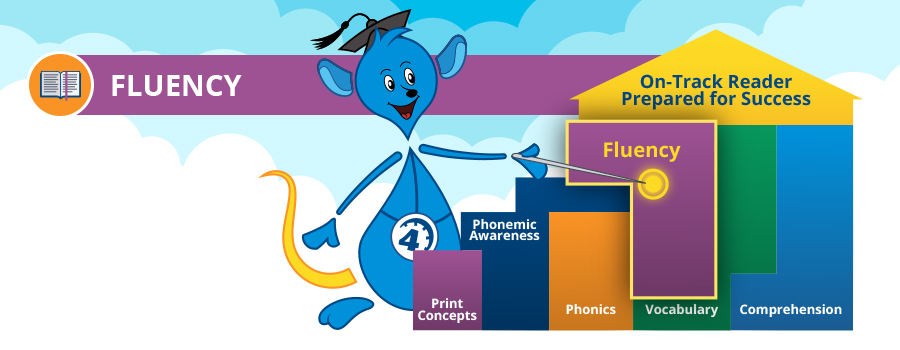
Reading fluency is one of the components of the reading pyramid. It is the connection to a higher level of reading and understanding. When a child achieves fluency with her or her reading, a parent can know that they are well on their way to becoming a successful reader. The five key elements of reading are:
If you are like most parents, you aren’t sure what reading fluency is. You might even be confusing “reading fluency” with fluency with the English language (this is NOT what it means).
What is reading fluency, then? Fluency is the ability to read text accurately, quickly and with proper expression. It can be considered a bridge between the act of decoding words and the development of reading comprehension. As children become fluent readers, they begin to think less about the words and more about the meaning of the sentences they’re reading. When students incorporate reading fluency activities into their curriculum, they become able to respond to the material with emotion and thought.
Teaching Reading Fluency
A first benchmark for fluency is being able to “sight read” some words. If children can recognize, by sight, the most common words in written English, then instant reading of these words will allow them to read and understand text more quickly. Also, since there are many common English words that are so irregular according to the rules of phonics, it’s best to get children to just memorize them from the start. For example, try sounding out these words: “one”, “was”, “even”, or “the”.
Many experts warn, however, that an overemphasis on sight reading early on can be counterproductive. They posit that by having children focus on word memorization, they will avoid learning the important techniques of sounding out words. The bottom line is that as children master the rules of phonics, they should also master, by sight, at least the most commonly encountered and often irregular words. Teaching both sight word recognition and phonics—in tandem—is the ideal way to increase reading fluency.
How Reading Fluency Programs Can Help
Teaching reading fluency with online tools can provide great opportunities for children to follow along in the text as the program reads aloud and for timed readings. The best reading fluency programs will keep students engaged throughout the learning process.
With Time4Learning, these fluency skills are taught and reinforced in a number of ways. Time4Learning teaches young readers important skills that are required to become fluent readers. The animated lessons allow young readers to interact with the text instead of just reading it, which both engages and challenges them. Plus, the student-paced nature of the program allows them to repeat or practice a lesson as many times as they want, which is important for retention.
Time4Learning’s complete language arts curriculum includes dozens of activities designed to build reading fluency. Activities to help with reading fluency include:
- Reinforcement of phonemic awareness to ensure accuracy
- Emphasis on sight word vocabulary that leads to quick word recognition
- Modeling of correct intonation and expression with each story
- The ability to click for more information on unfamiliar words while reading