Best homeschooling Resource

Homeschoo Statistics
Data on Homeschooling

How many Americans are Homeschooling?
Should you believe the oft-quoted statistics?


Free Newsletter on Homeschooling
First Name:  Last Name: 
E-mail Address: 
Site MapMember LoginSign Up

home schooling

"After the fourth change of schools in two years, Mom decided to homeschool us "


homeschooling program

home
reading
math
homeschool Curriculum
preschool -    elementary
games
Learning
Time4Learning Lesson Plans
about us

Build math and reading skills

Self paced learning

Interactive Homeschool Material

Continuously updated curriculum

First lessons, then fun

Interactive Homeschooling Resources

Preschool through eighth grade materials

learn about homeschooling curriculum
or
get homeschooling help online

Homeschool Statistics
The government says that 1.1 million students are homeschooled.

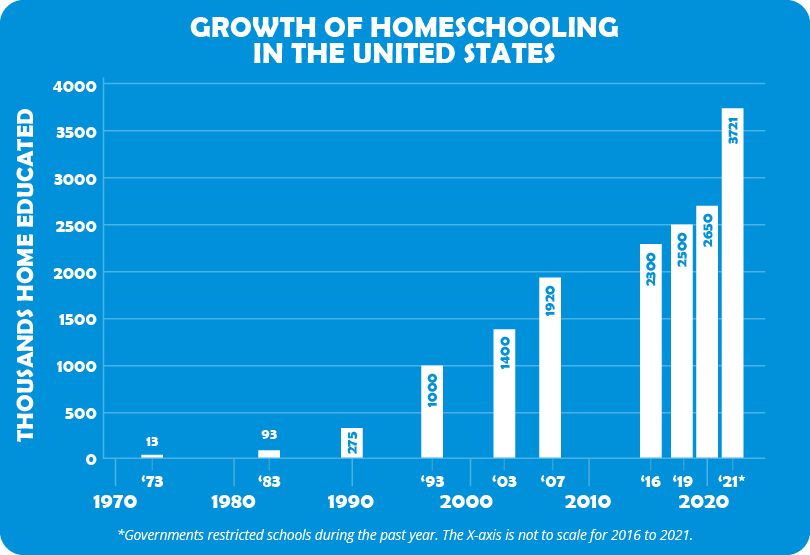
The most recent Federal Government study concluded that about 2.2% of the K-12 students or 1.1 million students were being homeschooled in the United States as of spring 2003.

The study was performed by the National Household Education Survey Program (NHES) and the results are available on the Dept of Education Website as part of the National Centers for Educational Statistics.

In considering how large and significant the homeschooling movement is, I would ask questions about the trend, the reliability, definitions, and timeliness of these statistics.

Homeschool Statistical Trends

The government homeschool statistics show just over a 6% annual increase since they estimated only 1.7% or 850,000 students were being homeschooled in 1999 versus 2.2% or 1.1 million students (1,096,000) homeschooled students in 2003.

I believe that the government is right in recognizing that homeschooling is growing rapidly. I think it is growing more rapidly than they say.

How Fast is Homeschooling Growing? While I don't have a solid basis for estimation, I know that amongst the reasons for homeschooling are that parents feel that public schools over focus on the wrong issues (such as test preparation and test scores), that public schools are dangerous, and that the costs of private schools are often out-of-reach.

In the last few years, these trends have all accelerated. Private schools of quality have gotten really expensive. The shootings at schools, the 911 and the government emphasis on the constant threat of terrorism, and the huge impact of the No Child Left Behind testing have all vastly contributed to accelerating the homeschool movement.


Reliability of government homeschool study

Let's say that you had lost faith (or never had faith) in the traditional school system for your family and you decided to homeschool. You should try to understand the laws about your state's rules in homeschooling and you might even be able to understand and follow them precisely. Or, you might have done a reasonably good effort of understanding them and following the laws but you might have doubts as to whether you were fully compliant.


When the government called to survey your family situation, would you be really eager to participate in their survey? Would you quickly tell them that you had decided to keep the kids home?

Well, my point is this. Irrespective of how you personally would handle this situation, the fact is that the homeschool-types are not the ones most diligently reporting data into the government. They keep their heads down and they do not send in any superfluous information to the government. Without risk of overgeneralizing, it is safe to say that they are "pretty annoyed" about how much of their tax money is going into school systems and surveys which they don't feel helps them much.

I think the government undercounted the homeschoolers since they tend to not participate in government surveys, particularly about their children.


The Definition of Homeschooling - Murkier than you might think

Students are considered to be homeschooled if their parents reported them as being schooled at home instead of at a public or private school for at least part of their education and if their part-time enrollment in public or private schools did not exceed 25 hours a week. Students who were schooled at home only because of a temporary illness were not included as homeschoolers. DOE's National Centers for Statistics. Lets consider what this means.


What about kids in umbrella schools? In Florida, for instance, families can homeschool but must provide a certain amount of direct reporting including an annual evaluation to their school district. One very popular method of avoiding these responsibilities is to enroll your student in an Unbrella School (or Cover School). The family has now legally enrolled their child in a private school and has no reporting requirements to the state.

What about publicly supported homeschools? In California and Alaska and Florida, there are now "homeschool charter schools" and "homeschool public schools", a mind-bending set of new combinations. Essentially, the homeschool charter schools get the funds ("full time student equivalents) from the state to take responsibility for the children's education. Then, they enroll students and provide distance education. In Florida, the state itself has opened a distance learning virtual school (Florida Virtual School) that provides homeschool education.


Are these children being homeschooled? Yes they are. Well, many would argue that those enrolled in publicly financed distance learning program are not "truly homeschooling".

Are they counted in the government statistics? I don't think so.


Are these homeschooled children who do not get reported statistically important? Yes, counting the number of children that would appear to be homeschooled but who are not counted due to the definitions might double the number of homeschooled children.


How Timely or Current Are the Statistics


The last two government counts of the homeschool market were in the spring of 1999 and 2003. Quite possibly, in the spring of 2007 (which is now past), a new government count is being done. I'm sure that it will report that homeschooling has grown and I hope it will engage a bit more on the definitions.

Homeschooling: Large, Growing, and Underreported - So.....


Like many complex dynamics issues, the data around homeschooling is murky and out of date. The last large scale study was in 2003 and it reported that 2.2% of the population was being homeschooled. Here's my thoughts and questions on the statistics:


  1. The government underestimated the number of families "homeschooling" both because many homeschoolers fail to report and because their definition does not count the families who educate their children at home and on their own terms while having them nominally enrolled in a cover school for adminstrative and legal reasons.
  2. The real number of children homeschooled in 2003 could have been twice as large as the government reported, say 4.4% (I believe)
  3. The growth in homeschooling is strong and accelerating. Based on attendence at homeschool events and the financial growth of homeschool vendors, the 6% annual increase appears to be low. As homeschooling gets mainstream acceptance and better supplies, it appears to be accelerating.
  4. Despite all the discussions about education at the federal and state level, I have not yet heard a highly placed public figure take a position on homeschooling or even to raise the question of what this phenomenon means for us as a society.

The Significance of Homeschooling


Two percent of the population homeschooling is huge: five percent is mind-blowing. And so far, the significance of this trend is not really discussed or understood. Yes, these kids are protected from harmful influences at school. Yes these kids get alot of personal attention. Yes, these kids learn to spell really really well. Yes, they go to college and to fine colleges in disproportionately high numbers. Yes, they've shown themselves to be creative (the best-seller book Ergon was written by homeschooler in high school). But, overall where does this trend lead? What does it mean for us as a society? What about when its an immigrant groups that decide to homeschool and to do it with an education that is very alien and foreign to American values?


The Best Homeschooling Resource: Time4Learning

Have you noticed how much your children like learning on the computer? The computer and internet have become valuable tools for homeschooling parents.

Online learning
can form the core of the homeschooling curriculum or can supplement other programs. Many parents consider Time4Learning's online system to be the Best Homeschooling Program.

As one ten year old boy put it: "Time4Learning is the best. It's official. We use several curricula but Time4Learning is the best."

Time4Learning is a great homeschooling partner. Time4Learning is a small family-owned business that strives to treat each member personally. We answer every email daily (including weekends!). We provide ongoing technical assistance and an active parents forum where parents can discuss their homeschooling ideas.

Time4Learning is a great homeschool curriculum choice. Some parents use Time4Learning as supplementary, others use Time4Learning as the primary homeschooling curriculum. Time4Learning has curriculum for homeschooling children in Preschool, Grade School, and Middle School.

Are you an Accidental Homeschooler?

Are you new to homeschooling? Get a free Introduction to Homeschooling ebook.

I want to Learn More about Time4Learning's Homeschool Online Program.

Time4Learning has helped thousands of children Start Helping My Children Now.


Are you new to homeschooling? Ask Time4Learning for their free Introduction to Homeschooling ebook.

------------------------------

An Accidental Homeschooler Story:

Because of sudden health problems, we make the wholly unexpected decision to homeschool him "for awhile".


During that first year, we also discovered the little guy was also quite gifted...


When he got better, I couldn't bring myself to send him back to a traditional classroom when homeschool was obviously meeting his needs so well...

And when number two son came along, we started him out in a schools where his teachers quickly noted some learning difficulties.

Now, were we supposed to leave our learning disabled son in a classroom where he might receive professional services or might not?
Well, we could have, but we didn’t.


He is now in fifth grade and is reading and testing at grade level and above. Go figure.
I guess you could call our family the ‘Accidental Homeschoolers.’


We didn’t plan to homeschool, and we didn’t really even choose to. Though we are a family of faith, we didn’t homeschool for religious reasons, as many do. We aren't philosophically opposed to public schools. Nor or we adventurers seeking a road less traveled. We didn’t find inherent fault with mainstream educational philosophies, or get fed up with a particular teacher, or even give up because the gifted and special education programs in our local school system were less than perfect. We simply had a child who got sick, and we decided to homeschool him, and it worked. And then we decided to give it another try with a totally different kiddo, and it worked again. Purely accidental.

Kerry Jones, Homeschooling Mother, Atlanta Georgia, Jan 2007

Contact Us
Privacy Policy
Member Login
Homeschool Online
Parent Signup Information