Curriculum Uses
Curriculum Levels
Benefits
- Online Curriculum for
PreK to 8th Grades
- Access to 3 Grade Levels of Lessons
- 1,000+ Student-Paced Multimedia Activities
- Language Arts, Math, Science & Social Studies
- Interactive, Project-Based Activities
- Detailed Reporting for
Easy Record-Keeping
- Lesson Plans & Teaching Tools for Parents
- Lessons Correlated to State Standards
What Do Parents Say?
I LOVE Time4Learning! It holds the attention of my kids, plus I can keep track of their learning without hovering over their shoulders.
I'm so thankful for your program! My kids have so much fun with the activities that they don't even notice that they're learning!
I am really pleased with Time4Learning. It has made a world of difference in my son's academic performance in school!
|
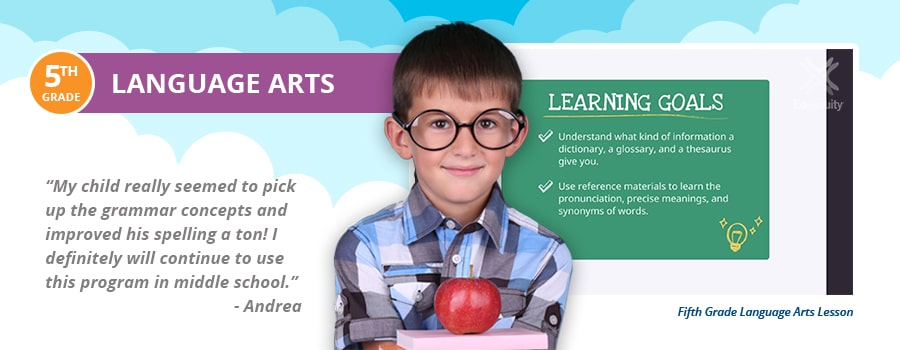
Language Arts -5th Grade Lesson Plans
Time4Learning is an online student-paced learning system covering preschool through middle school. It is popular as a fifth grade homeschool curriculum, for afterschool enrichment, for remediation, and for summer study. If you are just learning about Time4Learning, we'd suggest first looking at our interactive lesson demos.
The lesson plans below provide a detailed list of the language arts and language arts extensions, with brief activity descriptions and learning activity (LA) numbers. Additional resources related to fifth grade language arts are also provided.
Members often use this page as a resource for more detailed planning, to choose specific activities using the activity finder or to compare our curriculum with state standards.
Fifth grade language arts is organized into two large sections:
- Language Arts - 159 Activities
- Language Arts Extensions - 210 Activities
Non-Scored
|
Scored
|
Worksheet
|
Answer Key
|
Quiz
|
| Synonyms: The student will demonstrate knowledge by determining the meaning of synonyms from grade level appropriate vocabulary, by correctly choosing a given word or phrase that means the same thing, in reading activities that incorporate explicit instruction and application. |
Synonyms: Interactive Guided Instruction |
 |
R5002 |
|
|
| Synonyms: Quiz 1 |
 |
R5003 |
|
|
| Synonyms: Let Me Practice |
 |
R5004 |
|
|
| Synonyms: Quiz 2 |
 |
R5005 |
|
|
| Antonyms: The student will demonstrate knowledge by determining the meaning of antonyms from grade level appropriate vocabulary, by correctly choosing a given word or phrase that means the opposite, in reading activities that incorporate explicit instruction and application. |
Antonyms: Interactive Guided Instruction |
 |
R5007 |
|
|
| Antonyms: Quiz 1 |
 |
R5008 |
|
|
| Antonyms: Let Me Practice |
 |
R5009 |
|
|
| Antonyms: Quiz 2 |
 |
R5010 |
|
|
| Prefixes: The student will be able to analyze and determine the correct meaning of a word, based on the prefix of the root word or how the prefix is used in the context of a passage. |
Prefixes: Interactive Guided Instruction |
 |
R5012 |
|
|
| Prefixes: Quiz 1 |
 |
R5013 |
|
|
| Prefixes: Let Me Practice |
 |
R5014 |
|
|
| Prefixes: Quiz 2 |
 |
R5015 |
|
|
| Suffixes: The student will be able to analyze and determine the correct meaning of a word, based on the prefix of the root word or how the prefix is used in the context of a passage. |
Suffixes: Interactive Guided Instruction |
 |
R5017 |
|
|
| Suffixes: Quiz 1 |
 |
R5018 |
|
|
| Suffixes: Let Me Practice |
 |
R5019 |
|
|
| Suffixes: Quiz 2 |
 |
R5020 |
|
|
| Homophones: The student will be able to identify and select the appropriate homophone or word that sounds the same, based on the context of a passage which fits the best meaning of the given word or phrase. |
Homophones: Interactive Guided Instruction |
 |
R5022 |
|
|
| Homophones: Quiz 1 |
 |
R5023 |
|
|
| Homophones: Let Me Practice |
 |
R5024 |
|
|
| Homophones: Quiz 2 |
 |
R5025 |
|
|
| Idioms: The student will be able to identify and analyze the author's use of idioms, based on the context of a passage and how these expressions are used in literal and interpretative information. |
Idioms: Interactive Guided Instruction |
 |
R5027 |
|
|
| Idioms: Quiz 1 |
 |
R5028 |
|
|
| Idioms: Let Me Practice |
 |
R5029 |
|
|
| Idioms: Quiz 2 |
 |
R5030 |
|
|
| Latin and Greek Roots: The student will be able to identify and determine the meaning of unknown words, based on the understanding of Latin and Greek roots. |
Greek and Latin Root Words: Interactive Guided Instruction |
 |
R5032 |
|
|
| Greek and Latin Root Words: Quiz 1 |
 |
R5033 |
|
|
| Greek and Latin Root Words: Let Me Practice |
 |
R5034 |
|
|
| Greek and Latin Root Words: Quiz 2 |
 |
R5035 |
|
|
| Think Aloud Level 1: Use the reading comprehension process skills of summarizing, predicting, visualizing, questioning, and clarifying with extensive scaffolding and support, through think aloud prompts. |
Think Aloud - Level 1 - Part 1 (fiction) |
 |
R5111 |
|
|
| Think Aloud - Level 1 - Part 2 (nonfiction) |
 |
R5112 |
|
|
| Think Aloud - Level 1 - Part 3 (fiction) |
 |
R5113 |
|
|
| Think Aloud - Level 1 - Part 4 (nonfiction) |
 |
R5114 |
|
|
| Think Aloud Level 2: Use the reading comprehension process skills of summarizing, predicting, visualizing, questioning, and clarifying with scaffolding and support, through think aloud prompts. |
Think Aloud - Level 2 - Part 2 (nonfiction) |
 |
R5116 |
|
|
| Think Aloud - Level 2 - Part 3 (fiction) |
 |
R5117 |
|
|
| Think Aloud Level 3: Use the reading comprehension process skills of summarizing, predicting, visualizing, questioning, and clarifying to independently read and comprehend texts with minimal think aloud support. |
Think Aloud - Level 3 - Part 1 (fiction) |
 |
R5118 |
|
|
| Think Aloud - Level 3 - Part 2 (fiction) |
 |
R5119 |
|
|
| Summarizing: Make a summary or paraphrase information from literary or expository texts. |
Summarizing: Interactive Guided Instruction |
 |
R5044 |
|
|
| Summarizing: Quiz 1 |
 |
R5045 |
|
|
| Summarizing: Quiz 2 |
 |
R5046 |
|
|
| Plot: Identify plot by using story elements including the main problem and solution. |
Plot: Interactive Guided Instruction |
 |
R5057 |
|
|
| Plot: Quiz 1 |
 |
R5058 |
|
|
| Plot: Quiz 2 |
 |
R5059 |
|
|
| Main Idea & Supporting Details - Non-Fiction: Identify the main idea(s) using the supporting details in an expository text. |
Main Idea/Supporting Details-Non-Fiction: Interactive Guided Instruction |
 |
R5048 |
|
|
| Main Idea/Supporting Details-Non-Fiction: Quiz 1 |
 |
R5049 |
|
|
| Main Idea/Supporting Details-Non-Fiction: Quiz 2 |
 |
R5050 |
|
|
| Main Idea and Theme - Fiction: Identify, summarize, or explain the main idea(s) or theme(s) using the supporting details and symbolism in a literary text. |
Theme & Main Idea-Fiction: Interactive Guided Instruction |
 |
R5051 |
|
|
| Theme & Main Idea-Fiction: Quiz 1 |
 |
R5052 |
|
|
| Theme & Main Idea-Fiction: Quiz 2 |
 |
R5053 |
|
|
| Fact and Opinion: Distinguish between fact and opinion in an expository text or within news sources, including the use of hyperbole. |
Fact and Opinion: Interactive Guided Instruction |
 |
R5069 |
|
|
| Fact and Opinion: Quiz 1 |
 |
R5070 |
|
|
| Fact and Opinion: Quiz 2 |
 |
R5071 |
|
|
| Charts and Graphs: Read, interpret and make predictions using charts, graphs, diagrams, maps or other graphic representations. |
Interpreting Charts & Graphs: Interactive Guided Instruction |
 |
R5098 |
|
|
| Interpreting Charts & Graphs: Quiz 1 |
 |
R5099 |
|
|
| Interpreting Charts & Graphs: Quiz 2 |
 |
R5100 |
|
|
| Cause and Effect: Identify and distinguish between cause and effect in expository and literary texts. |
Cause and Effect: Interactive Guided Instruction |
 |
R5101 |
|
|
| Cause and Effect: Quiz 1 |
 |
R5102 |
|
|
| Cause and Effect: Quiz 2 |
 |
R5103 |
|
|
| Authors Purpose: Identify and use knowledge of the author's purpose to comprehend the writing of a literary or expository text. |
Author's Purpose: Interactive Guided Instruction |
 |
R5054 |
|
|
| Author's Purpose: Quiz 1 |
 |
R5055 |
|
|
| Author's Purpose: Quiz 2 |
 |
R5056 |
|
|
| Making Inferences and Drawing Conclusions: Use knowledge, information, and ideas from literary or expository text to make inferences about the text (e.g., make inferences, draw conclusions, make generalizations, infer sequence of events, and infer a character's feelings, or traits). |
Inferencing: Interactive Guided Instruction A |
 |
R5037 |
|
|
| Inferencing: Quiz 1A |
 |
R5039 |
|
|
| Inferencing: Quiz 2A |
 |
R5041 |
|
|
| Inferencing: Interactive Guided Instruction B |
 |
R5038 |
|
|
| Inferencing: Quiz 1B |
 |
R5040 |
|
|
| Inferencing: Quiz 2B |
 |
R5042 |
|
|
| Compare and Contrast: Compare and contrast characters, settings, ideas, information and/or plot within a text or between two or more genre sources (literary or expository), including figurative language such as metaphors and personification. |
Compare and Contrast: Interactive Guided Instruction |
 |
R5080 |
|
|
| Compare and Contrast: Quiz 1 |
 |
R5081 |
|
|
| Compare and Contrast: Quiz 2 |
 |
R5082 |
|
|
| State Simulation Test: Students will demonstrate knowledge of comprehension skills on grade level appropriate literary and expository passages, with questions that simulate a high-stakes assessment. |
State Simulation Test 1 |
 |
R5120 |
|
|
| State Simulation Test 2 |
 |
R5121 |
|
|
| State Simulation Test 3 |
 |
R5122 |
|
|
| Evidence & Academic Language (A): Students will be introduced to academic words to increase language proficiency and activate background knowledge before analyzing two authentic nonfiction articles, "Iceland, Land of Fire and Ice" and "A Supervolcano," for evidence and supporting information. |
Vocabulary: Features, Mantle, Geyser, Mineral |
 |
R5123V |
|
|
| Activity Quiz: Features, Mantle, Geyser, Mineral |
 |
AQR5123V |
|
|
| Reason & Evidence A (Natural Wonders) |
 |
R5124I |
|
|
| Activity Quiz: Reason & Evidence A |
 |
AQR5124I |
|
|
| Odyssey Writer: Read & Respond (Yellowstone Features/Geysers) |
|
OWR5124I |
|
 |
| Evidence & Academic Language (B): Students will be introduced to academic words to increase language proficiency and activate background knowledge before analyzing two authentic nonfiction articles, "Scout Bassett: Succeeding in Life, One Step at a Time" and "Action!," for evidence and supporting information. |
Vocabulary: Obstacle, Artificial, Amputate, Quadriplegic |
 |
R5125V |
|
|
| Activity Quiz: Obstacle, Artificial, Amputate, Quadriplegic |
 |
AQR5125V |
|
|
| Reason & Evidence B (Differences) |
 |
R5126I |
|
|
| Activity Quiz: Reason & Evidence B |
 |
AQR5126I |
|
|
| Evidence & Proverbs (C): Students will explore the meaning of five different proverbs to increase language proficiency before analyzing two authentic nonfiction articles, "Treasures of the Tomb" and "Guardians of the Tomb," for evidence and supporting information. |
Vocabulary: Proverbs |
 |
R5127V |
|
|
| Activity Quiz: Proverbs |
 |
AQR5127V |
|
|
| Reason & Evidence C (Tombs) |
 |
R5128I |
|
|
| Activity Quiz: Reason & Evidence C |
 |
AQR5128I |
|
|
| Odyssey Writer: Read & Respond (Reasons and Evidence) |
|
OWR5128I |
|
 |
| Comparing Structure (A): Students will understand two different text structures: chronological order and cause and effect. They will apply these skills by comparing and contrasting two authentic nonfiction articles, "Death Valley Days" and "Pedal Power." As an extension, they will practice using reference materials. |
Compare & Contrast A (Bicycle & Death Valley) |
 |
R5129I |
|
|
| Activity Quiz: Compare & Contrast A |
 |
AQR5129I |
|
|
| Odyssey Writer: Dictionary |
|
OWR5129I |
|
 |
| Comparing Structure (B): Students will understand two different text structures: chronological order and cause and effect. They will apply these skills by comparing and contrasting two authentic nonfiction articles, "Gold Fever" and "A Different Way to Wake Up." |
Compare & Contrast B (Alarm & Gold Rush) |
 |
R5130I |
|
|
| Activity Quiz: Compare & Contrast B |
 |
AQR5130I |
|
|
| Odyssey Writer: Read & Respond (Text Structure) |
|
OWR5130I |
|
 |
| Integrating Information (A): Students will understand the basic steps one must take when organizing notes from two sources. Students will independently read two nonfiction articles, "Wildlife Watch, Baboon Burglars" and "Culture Trek: Kenya," and will integrate information from both in order to create a cohesive piece of writing. |
Integrating Information A (Kenya) |
 |
R5131I |
|
|
| Activity Quiz: Integrating Information A |
 |
AQR5131I |
|
|
| Integrating Information (B): Students will review the basic steps to take when organizing notes from two sources. They will independently read two nonfiction articles, "Eye in the Sky" and "Space Junk," and will integrate information from both in order to create a simulated speech about satellites in outer space. |
Integrating Information B (Space) |
 |
R5132I |
|
|
| Activity Quiz: Integrating Information B |
 |
AQR5132I |
|
|
| Integrating Information (C): Students will review the basic steps for taking notes and organizing notes from two sources. They will independently read two nonfiction articles, "Crystals" and "Curse of the Hope Diamond," integrate the information, and respond to their learning in writing. |
Integrating Information C (Gems) |
 |
R5133I |
|
|
| Activity Quiz: Integrating Information C |
 |
AQR5133I |
|
|
| Odyssey Writer: Open Response (Gems) |
|
OWR5133I |
 |
 |
| Before Reading: The student will explore content through discovery and develop vocabulary through the use of a literature-based glossary. |
Background (Prereading for An American Safari) |
 |
56324 |
|
|
| Vocabulary (A Glossary for An American Safari) |
 |
56325 |
|
|
| During Reading: The student will achieve comprehension by reading literature with emphasis on vocabulary and respond to the literature. Authentic nonfiction literature is included. |
Literature: An American Safari |
 |
56326 |
 |
|
| After Reading: The student will use a variety of strategies to comprehend reading selections. Student uses prior knowledge and will analyze and evaluate to make sense of texts. Student will monitor his or her own comprehension and act purposefully when comprehension breaks down using strategies. Student will write for different purposes and write a variety of compositions based on practical and literary prompts and complete a research-writing project. |
Comprehension 1: An American Safari (author's purpose) |
 |
56327 |
|
|
| Comprehension 2: An American Safari (fact or opinion) |
 |
56328 |
|
|
| Writing 1: Proposal Letter |
|
56329 |
|
 |
| Letter of Persuasion (writing: letter) |
 |
56382 |
|
|
| Writing 2: Persuasive Essay |
|
56330 |
|
 |
| Using Persuasion (writing: persuasive) |
 |
56383 |
|
|
| Final Project: An American Safari (research endangered animals) |
 |
56331 |
 |
|
| Language Arts: Through learning activities focused on recognition and application, the student will practice language art skills. These activities have direct instruction, practice, and scored assessment. |
Declarative and Interrogative (Sentences) |
 |
56332 |
|
|
| Imperative and Exclamatory (Sentences) |
 |
56333 |
|
|
| Before Reading: The student will explore content through discovery and develop vocabulary through the use of a literature-based glossary. |
Background (Prereading for The Birchbark House) |
 |
56334 |
 |
|
| Vocabulary (A Glossary for The Birchbark House) |
 |
56335 |
 |
|
| During Reading: The student will achieve comprehension by reading literature with emphasis on vocabulary and respond to the literature. Authentic fiction literature is included. |
Literature: The Birchbark House |
 |
56336 |
 |
|
| After Reading: The student will use a variety of strategies to comprehend reading selections. Student uses prior knowledge and will analyze and evaluate to make sense of texts. Student will monitor his or her own comprehension and act purposefully when comprehension breaks down using strategies. Student will write for different purposes and write a variety of compositions based on practical and literary prompts and complete a research-writing project. |
Comprehension 1: The Birchbark House (character, plot, setting) |
 |
56337 |
|
|
| Comprehension 2: The Birchbark House (inferences)(compare/contrast) |
 |
56338 |
|
|
| Writing 1: Safety Guide |
|
56339 |
|
 |
| Using Description (writing: narrative) |
 |
56384 |
|
|
| Writing 2: Informative Article |
|
56340 |
|
 |
| Writing to Inform |
 |
56385 |
|
|
| Final Project: The Birchbark House (Ojibwa People) |
 |
56341 |
 |
|
| Language Arts: Through learning activities focused on recognition and application, the student will practice language art skills. These activities have direct instruction, practice, and scored assessment. |
Common and Proper Nouns |
 |
56353 |
|
|
| Irregular Plural Nouns |
 |
56354 |
|
|
| Before Reading: The student will explore content through discovery and develop vocabulary through the use of a literature-based glossary. |
Background (Prereading: The Giver) |
 |
56344 |
 |
|
| Vocabulary (The Giver) |
 |
56345 |
 |
|
| During Reading: The student will achieve comprehension by reading literature with emphasis on vocabulary and respond to the literature. Authentic fiction literature is included. |
Literature: The Giver |
 |
56346 |
 |
|
| After Reading: The student will use a variety of strategies to comprehend reading selections. Student uses prior knowledge and will analyze and evaluate to make sense of texts. Student will monitor his or her own comprehension and act purposefully when comprehension breaks down using strategies. Student will write for different purposes and write a variety of compositions based on practical and literary prompts and complete a research-writing project. |
Comprehension 1: The Giver (summarize) |
 |
56348 |
|
|
| Comprehension 2: The Giver (compare/contrast) |
 |
56349 |
|
|
| Writing 1: Email |
|
56350 |
|
 |
| Writing a Narrative |
 |
56386 |
|
|
| Writing 2: Fantasy / Short Story |
|
56351 |
|
 |
| Short Story (writing) |
 |
56387 |
|
|
| Final Project: The Giver (research career of choice) |
 |
56352 |
 |
|
| Language Arts: Through learning activities focused on recognition and application, the student will practice language art skills. These activities have direct instruction, practice, and scored assessment. |
Common and Proper Nouns |
 |
56353 |
|
|
| Irregular Plural Nouns |
 |
56354 |
|
|
| Before Reading: The student will explore content through discovery and develop vocabulary through the use of a literature-based glossary. |
Background (Prereading: Mother and Daughter) |
 |
56355 |
 |
|
| Vocabulary (Mother and Daughter) |
 |
56356 |
 |
|
| During Reading: The student will achieve comprehension by reading literature with emphasis on vocabulary and respond to the literature. Authentic fiction literature is included. |
Literature: Mother and Daughter |
 |
56357 |
 |
|
| After Reading: The student will use a variety of strategies to comprehend reading selections. Student uses prior knowledge and will analyze and evaluate to make sense of texts. Student will monitor his or her own comprehension and act purposefully when comprehension breaks down using strategies. Student will write for different purposes and write a variety of compositions based on practical and literary prompts and complete a research-writing project. |
Comprehension 1: Mother and Daughter (cause and effect) |
 |
56358 |
|
|
| Comprehension 2: Mother and Daughter (draw conclusions) |
 |
56359 |
|
|
| Writing 1: Diary Entries |
|
56360 |
|
 |
| Personal Narrative (writing) |
 |
56388 |
|
|
| Writing 2: Narrative Using Figurative Language |
|
56361 |
|
 |
| Writing with Figurative Language |
 |
56389 |
|
|
| Final Project: Mother and Daughter (Mexican-American Culture) |
 |
56362 |
 |
|
| Language Arts: Through learning activities focused on recognition and application, the student will practice language art skills. These activities have direct instruction, practice, and scored assessment. |
Using Commas |
 |
56363 |
|
|
| Synonyms |
 |
56364 |
|
|
Non-Scored
|
Scored
|
Worksheet
|
Answer Key
|
Quiz
|
| Using Text Organizers: Use text organizers, such as type, headings, and graphics, to predict and categorize information in informational texts. |
Text Organizers |
 |
5286 |
|
|
| Understanding Reading Material (text organizers) |
 |
5287 |
|
|
| Lesson Quiz: Using Text Organizers |
 |
|
|
|
| Structure of Words: Use context clues to determine the meaning of unfamiliar words. |
Using Context Clues when Reading |
 |
5276 |
|
|
| Word Structure (prefixes, suffixes, root words) |
 |
5277 |
|
|
| Lesson Quiz: Structure of Words |
 |
|
|
|
| Text Elements: Use text elements, such as time sequences, for understanding materials. |
What Happened Next? (chronological order) |
 |
5275 |
|
|
| Understanding Time Sequence (chronological order) |
 |
5226 |
|
|
| Lesson Quiz:Text Elements |
 |
|
|
|
| Interpreting Text: Retell main points to demonstrate interpretation of challenging texts. |
Retell, Relearn (retell a story) |
 |
5299 |
|
|
| Retell a Story |
 |
5101 |
|
|
| Lesson Quiz: Interpreting Text |
 |
|
|
|
| Summarizing: Summarize and paraphrase written materials. |
Summarize and Paraphrase Written Materials |
 |
5237 |
|
|
| Summarizing |
 |
5270 |
|
|
| Lesson Quiz: Summarizing |
 |
|
|
|
| Cause & Effect: Identify cause-and-effect relationships |
Cause and Effect |
 |
5261 |
|
|
| Identify Cause-and-Effect Relationships |
 |
5224 |
|
|
| Lesson Quiz: Cause & Effect |
 |
|
|
|
| Using Affixes: Identify the meaning of affixes. |
Identify Affixes (prefixes and suffixes) |
 |
5228 |
|
|
| Affixes (prefixes and suffixes) |
 |
5268 |
|
|
| Lesson Quiz: Using Affixes |
 |
|
|
|
| The Purpose of Reading: Set purposes for reading. |
Reading with a Purpose (reading strategies) |
 |
5297 |
|
|
| Reasons to Read (reading strategies) |
 |
5298 |
|
|
| Lesson Quiz: The Purpose of Reading |
 |
|
|
|
| Write What You Read: Write about what is read. |
Call to Freedom (develop comprehension) |
 |
5264 |
|
|
| Across Five Aprils (read and respond) |
 |
5203 |
|
|
| Lesson Quiz: Write What You Read |
 |
|
|
|
| Vocabulary 1: Increase personal vocabulary and enhance language use Unit 1: Words with Greek parts, including ''astronomy, hemisphere, microscope, monologue, geology, biography, democracy, television, odometer, autograph.'' |
Vocabulary (Greek roots) |
 |
5181 |
|
|
| Lesson Quiz: Vocabulary 1 |
 |
|
|
|
| Vocabulary 2: Increase personal vocabulary and enhance language use Unit 2: Words taken from a person's name (eponyms) which may include, ''diesel, galvanize, zeppelin, watt, saxophone, bloomers, braille, pasteurize, nicotine.'' |
Vocabulary (eponyms) |
 |
5182 |
|
|
| Lesson Quiz: Vocabulary 2 |
 |
|
|
|
| Vocabulary 3: Increase personal vocabulary and enhance language use Unit 3: Blended words (portmanteaus), which may include chortle, smog, Chunnel, motel, splatter, meld, dumbfound, brunch, bit, splurge. |
Vocabulary (blended words) |
 |
5183 |
|
|
| Lesson Quiz: Vocabulary 3 |
 |
|
|
|
| Vocabulary 4: Increase personal vocabulary and enhance language use Unit 4: Phrases and sayings common to American culture, which may include Bite the hand that feeds you, Every cloud has a silver lining, Make a mountain out of a molehill, Out of the frying pan into the fire, Read between the lines, Sit on the fence, His name is mud. |
Vocabulary (phrases and sayings) |
 |
5184 |
|
|
| Lesson Quiz: Vocabulary 4 |
 |
|
|
|
| Vocabulary 5: Increase personal vocabulary and enhance language use Unit 5: Names of occupations, which may include journalist, paleontologist, cartographer, architect, composer, interpreter, meteorologist, surveyor, telemarketer, plumber. |
Vocabulary (occupations) |
 |
5185 |
|
|
| Lesson Quiz: Vocabulary 5 |
 |
|
|
|
| Vocabulary 6: Increase personal vocabulary and enhance language use Unit 6: Words from the Civil War, which may include secession, emancipation, confederate, assassination, reconstruction, Yankee, surrender, rebellion, scalawag, carpetbagger. |
Vocabulary (American Civil War) |
 |
5186 |
|
|
| Lesson Quiz: Vocabulary 6 |
 |
|
|
|
| Vocabulary 7: Increase personal vocabulary and enhance language use Unit 7: Words taken from the names of Greek gods or heroes, which may include titanic, narcissistic, panic, tantalize, atlas, herculean, hypnosis, morphine, mentor, amazon. |
Vocabulary (Greek Mythology) |
 |
5187 |
|
|
| Lesson Quiz: Vocabulary 7 |
 |
|
|
|
| Vocabulary 8: Increase personal vocabulary and enhance language use Unit 8: Common abbreviations and short forms of words, including ID, VIP, exam, gym, flu, ASAP, co-op, info, sitcom, sci-fi. |
Vocabulary (abbreviations) |
 |
5188 |
|
|
| Lesson Quiz: Vocabulary 8 |
 |
|
|
|
| Vocabulary 9: Increase personal vocabulary and enhance language use Unit 9: Names for groups of animals, which may include pack, school, muster, pod, gang, gaggle, swarm, pride, drift, herd. |
Vocabulary (animal groups) |
 |
5189 |
|
|
| Lesson Quiz: Vocabulary 9 |
 |
|
|
|
| Vocabulary 10: Increase personal vocabulary and enhance language use Unit 10: Similar words that may be confusing, which may include conscience, conscious; desert, dessert; fatal, fateful; principal, principle; loose, lose. |
Vocabulary (similar word pairs) |
 |
5190 |
|
|
| Lesson Quiz: Vocabulary 10 |
 |
|
|
|
| Chapter Test: Reading Strategies - Extension: |
|
| Punctuation: Use internal punctuation to separate word groups. |
Word Clause Punctuation |
 |
5146 |
|
|
| Using Punctuation: Commas and Semicolons |
 |
5293 |
|
|
| Reviewing Punctuation |
 |
5294 |
|
|
| Lesson Quiz: Punctuation |
 |
|
|
|
| Comma Rules: Use commas after: yes, no, well, direct address, last name written first. |
Commas |
 |
5288 |
|
|
| Reviewing Commas |
 |
5289 |
|
|
| Lesson Quiz: Comma Rules |
 |
|
|
|
| Using Quotation Marks: Use quotation marks in dialogue, in names of poems, songs, short stories, magazine articles, and essays. |
Using Quotation Marks |
 |
5234 |
|
|
| Quotation Marks in Dialogues and Titles |
 |
5235 |
|
|
| Lesson Quiz: Using Quotation Marks |
 |
|
|
|
| Verb Tenses: Identify present, past, and future tenses of verbs. |
Showing Time with Verbs (verb tense) |
 |
5225 |
|
|
| Present, Past, Future: Verb Tenses |
 |
5212 |
|
|
| Vibrant Verbs (verb tense) |
 |
5147 |
|
|
| Lesson Quiz: Verb Tenses |
 |
|
|
|
| Linking Verbs: Identify linking verbs. |
Review of Linking Verbs |
 |
5217 |
|
|
| Linking Verbs |
 |
5208 |
|
|
| Lesson Quiz: Linking Verbs |
 |
|
|
|
| Irregular Verbs: Identify and use the past and past-participle forms of irregular verbs. |
Irregular Verbs: Past and Past Participle Forms |
 |
5211 |
|
|
| More Irregular Verbs |
 |
5227 |
|
|
| Lesson Quiz: Irregular Verbs |
 |
|
|
|
| Direct & Indirect Objects: Identify direct and indirect objects. |
Indirect Objects |
 |
5209 |
|
|
| Reviewing Direct and Indirect Objects |
 |
5216 |
|
|
| Direct Objects |
 |
5210 |
|
|
| Lesson Quiz: Direct & Indirect Objects |
 |
|
|
|
| Predicate Adjectives: Identify and use predicate adjectives. |
Predicate Adjectives |
 |
5206 |
|
|
| Reviewing Predicate Adjectives |
 |
5220 |
|
|
| Lesson Quiz: Predicate Adjectives |
 |
|
|
|
| Using Adjectives: Identify and use comparative and superlative forms of adjectives with more and most and with -er and -est endings. |
Using Adjectives with More and Most |
 |
5204 |
|
|
| Comparative Adjectives Using -er and -est |
 |
5205 |
|
|
| Lesson Quiz: Using Adjectives |
 |
|
|
|
| Using Adjective Suffixes: Identify and use the adjective suffixes: -able, -ful, -less, -y. |
Suffixes |
 |
5269 |
|
|
| Lesson Quiz: Using Adjective Suffixes |
 |
|
|
|
| Using Adverbs: Identify and use comparative and superlative forms of adverbs. |
Fast, Faster, Fastest (comparison adverbs) |
 |
5248 |
|
|
| Using Adverbs for Comparison |
 |
5207 |
|
|
| Reviewing Comparison Adverbs |
 |
5221 |
|
|
| Comparison Using Adverbs |
 |
5249 |
|
|
| Lesson Quiz: Using Adverbs |
 |
|
|
|
| Homophones & Homographs: Identify and use homophone and homographs. |
Homophones and Homographs |
 |
5242 |
|
|
| To, Too, Two: Homophones and Homographs |
 |
5201 |
|
|
| Sound Alike or Look Alike? (homophones & homographs) |
 |
5243 |
|
|
| Lesson Quiz: Homophones & Homographs |
 |
|
|
|
| Hyphenated Compounds: Identify and write correctly one-word, two-word, and hyphenated compounds. |
Using Hyphens with Words and Numbers |
 |
5236 |
|
|
| Lesson Quiz: Hyphenated Compounds |
 |
|
|
|
| Chapter Test: Grammar - Extension: |
|
| Elements of Suspense: Describe the defining characteristics of suspense. Read suspense stories. |
On the Edge of Your Seat (suspense genre) |
 |
5232 |
|
|
| Suspenseful Stories |
 |
5233 |
|
|
| Lesson Quiz: Elements of Suspense |
 |
|
|
|
| Elements of Historical Fiction: Describe the defining characteristics of historical fiction. Read historical fiction stories. |
Historical Fiction about the Civil War |
 |
5202 |
|
|
| Historical Fiction: Life as a Slave |
 |
5290 |
|
|
| Lesson Quiz: Elements of Historical Fiction |
 |
|
|
|
| Elements of Traditional Tales: Describe the defining characteristics of traditional tales. Read traditional tales. |
Traditional Tales |
 |
5278 |
|
|
| Story Tales |
 |
5279 |
|
|
| Lesson Quiz: Elements of Traditional Tales |
 |
|
|
|
| Fables: Compare fables and stories from two or more cultures or time periods. |
Understanding Fables |
 |
5280 |
|
|
| Fables |
 |
5281 |
|
|
| Lesson Quiz: Fables |
 |
|
|
|
| Plot Development: Describe the development of plot, and explain how conflicts are resolved. |
How a Plot Develops |
 |
5282 |
|
|
| Teaching about Plot |
 |
5283 |
|
|
| Lesson Quiz: Plot Development |
 |
|
|
|
| Elements of Style: Describe how the author's choice of vocabulary and style contributes to the quality and enjoyment of selections. |
How an Author Enhances Reading (vocabulary and style) |
 |
5061 |
|
|
| Elements of Style |
 |
5064 |
|
|
| Lesson Quiz: Elements of Style |
 |
|
|
|
| Elements of Poetry: Describe the characteristics of free verse, rhymed, and patterned poetry. |
Elements of Poetry |
 |
5262 |
|
|
| Purely Poetry |
 |
5263 |
|
|
| Lesson Quiz: Elements of Poetry |
 |
|
|
|
| Onomatopoeia & Alliteration: Identify onomatopoeia and alliteration in poetry. |
Amazing Alliteration and "Oink," It's Onomatopoeia |
 |
5214 |
|
|
| Alliteration and Onomatopoeia in Poetry |
 |
5218 |
|
|
| Lesson Quiz: Onomatopoeia & Alliteration |
 |
|
|
|
| Figures of Speech in Poetry: Identify the use of literal and figurative language in written text, including imagery, metaphor and simile, symbol, and personification |
Figures of Speech in Poetry |
 |
5273 |
|
|
| Figures of Speech in Poetry |
 |
5274 |
|
|
| Lesson Quiz: Figures of Speech in Poetry |
 |
|
|
|
| Character Development: Describe character development in fiction and poetry selections. |
Character Development |
 |
5271 |
|
|
| Memorable Characters |
 |
5272 |
|
|
| Lesson Quiz: Character Development |
 |
|
|
|
| Greek Mythology: Describe character development in fiction and poetry selections of Greek Mythology. |
The Quest for Mt. Olympus (Greek Mythology) |
 |
5222 |
|
|
| The Legacy of Greek Mythology |
 |
5223 |
|
|
| Lesson Quiz: Greek Mythology |
 |
|
|
|
| The Gettysburg Address: Read and evaluate the Gettysburg Address. |
The Gettysburg Address |
 |
5213 |
|
|
| Lincoln's Famous Speech (Gettysburg Address) |
 |
5231 |
|
|
| Lesson Quiz: The Gettysburg Address |
 |
|
|
|
| Chapter Test: Literature - Extension: |
|
| Writing a Complete Paragraph: Write a complete paragraph by using a topic sentence and supporting sentences. |
Perfect Paragraphs |
 |
5215 |
|
|
| Writing Better Paragraphs |
 |
5219 |
|
|
| Lesson Quiz: Writing a Complete Paragraph |
 |
|
|
|
| Letter Writing: Write letters formatted for a specific purpose. |
Dear Mom and Dad (persuasive letters) |
 |
56006 |
|
|
| Writing Letters |
 |
5240 |
|
|
| Writing Letters Review |
 |
5241 |
|
|
| Letters for All Occasions |
 |
5069 |
|
|
| Lesson Quiz: Letter Writing |
 |
|
|
|
| Writing an Outline: Write an outline, organizing information by main ideas and supporting ideas. |
Proofreading Made Easy |
 |
5149 |
|
|
| Making an Outline |
 |
5244 |
|
|
| Starting Your Research (outline) |
 |
5250 |
|
|
| Lesson Quiz: Writing an Outline |
 |
|
|
|
| Writing a Research Report: Write a research report and cite reference sources. |
Research Report |
 |
5246 |
|
|
| Putting It All Together (research report) |
 |
5148 |
|
|
| Just the Facts (research report) |
 |
5068 |
|
|
| Lesson Quiz: Writing a Research Report |
 |
|
|
|
| Elements of a Story: Write narratives with common story elements, such as plot, character, theme and setting. |
Suspense in Funville (story elements) |
 |
56003 |
|
|
| How to Write a Story (story elements) |
 |
5200 |
|
|
| Elements of a Story |
 |
5252 |
|
|
| Lesson Quiz: Elements of a Story |
 |
|
|
|
| Composition Writing: Write compositions including both literal and figurative language. |
Literal and Figurative Language |
 |
5251 |
|
|
| Making a Point with Writing (literal and figurative language) |
 |
5100 |
|
|
| Lesson Quiz: Composition Writing |
 |
|
|
|
| Revision Strategies: Apply knowledge of revision strategies, such as combining sentences, substituting words, and expanding ideas. |
Revision |
 |
5065 |
|
|
| How to Revise Your Writing |
 |
5066 |
|
|
| Lesson Quiz: Revision Strategies |
 |
|
|
|
| Editing: Edit final copies of original writing for appropriate conventions of written language. |
Editing Your Work |
 |
5031 |
|
|
| Lesson Quiz: Editing |
 |
|
|
|
| Point of View: Distinguish between first- and third-person point of view. |
Point of View |
 |
5291 |
|
|
| Point of View in Literature |
 |
5292 |
|
|
| Lesson Quiz: Point of View |
 |
|
|
|
| Chapter Test: Elements of Writing - Extension: |
|
| Reading Aloud: Perform oral readings of prose and poetry. |
Reading Stories and Poems Aloud |
 |
5295 |
|
|
| Lesson Quiz: Reading Aloud |
 |
|
|
|
| Elements of Public Speaking: Demonstrate use of oral language effectively by control of eye contact, speaking rate, volume, and enunciation. |
How to Speak Effectively |
 |
5229 |
|
|
| Effective Speeches |
 |
5239 |
  |
|
| Lesson Quiz: Elements of Public Speaking |
 |
|
|
|
| Speaking Correctly: Use spoken language concisely and creatively, depending on the purpose of communication. |
Speak Well |
 |
5253 |
|
|
| Speak Clearly and Concisely |
 |
5254 |
|
|
| Lesson Quiz: Speaking Correctly |
 |
|
|
|
| Expressing Opinions: Express opinions respectfully. |
Express Yourself (opinions) |
 |
5230 |
|
|
| Express Yourself (opinions) |
 |
5285 |
|
|
| Lesson Quiz: Expressing Opinions |
 |
|
|
|
| Listening Effectively: Listen to, identify, and then summarize main ideas of a speech or lecture. |
Listening to Speeches (listening skills) |
 |
5265 |
|
|
| Main Ideas (listening skills with speeches) |
 |
5266 |
|
|
| Listening to Me (listening skills) |
 |
56014 |
|
|
| Lesson Quiz: Listening Effectively |
 |
|
|
|
| Working with Directions: Give, listen to, and follow directions. |
North, South, East, West (follow directions) |
 |
5260 |
|
|
| Directions (follow directions) |
 |
5284 |
|
|
| Lesson Quiz: Working with Directions |
 |
|
|
|
| Chapter Test: Tools for Learning - Extension: |
|
| Spelling with Prefixes: Consistently apply rules of spelling Unit 1: including disbelief, unidentified, unlimited, distrust, disorder, midnight, midyear, predetermined, misspell, mistreat, discourage, unclear, disconnect, disappear, midway, preexisted, prehistoric, preregistration, mislead, misunderstanding, disintegrate, unbuckle, unable, disagree, dishonest, midweek, pretext, precede, misprint, misfortune. |
Spelling Unit 1: Yellow Lesson (prefixes dis-, mis-, mid-, un-, pre-) |
 |
5170 |
|
|
| Spelling Unit 1: Purple Lesson (prefixes dis-, mis-, mid-, un-, pre-) |
 |
5171 |
|
|
| Spelling Unit 1: Orange Lesson (prefixes dis-, mis-, mid-, un-, pre-) |
 |
5172 |
|
|
| Lesson Quiz: Spelling with Prefixes |
 |
|
|
|
| Spelling: Consistently apply rules of spelling Unit 2: Understand the influence of other languages and cultures on the spelling of English words (etymology), including words from ancient Greece, 30 words, including alphabet, technology, amnesia, music, nausea, eon, panic, acrobat, kaleidoscope, magma, cheers, gymnasium, planet, caramel, thermostat, galaxy, almond, apology, melody, cylinder, character, talent, idea, cider, allergy, telescope, mustache, museum, ocean, cinnamon. |
Spelling Unit 2: Yellow Lesson (Greek etymology) |
 |
5150 |
|
|
| Spelling Unit 2: Purple Lesson (Greek etymology) |
 |
5151 |
|
|
| Spelling Unit 2: Orange Lesson (Greek etymology) |
 |
5152 |
|
|
| Lesson Quiz: Spelling |
 |
|
|
|
| Spelling with Silent Letters: Consistently apply rules of spelling Unit 3: Words containing silent letters, 30 words, including tomb, align, design, knead, limb, autumn, wrestle, wring, wrist, sigh, resign, aisle, gnat, solemn, wheeze, frightened, gnarled, hymn, knuckle, whistle, condemn, receipt, crumb, ballet, gnash, herb, rhythm, wholesome, whimper, Illinois. |
Spelling Unit 3: Yellow Lesson (silent letters) |
 |
5153 |
|
|
| Spelling Unit 3: Purple Lesson (silent letters) |
 |
5154 |
|
|
| Spelling Unit 3: Orange Lesson (silent letters) |
 |
5155 |
|
|
| Lesson Quiz: Spelling with Silent Letters |
 |
|
|
|
| Spelling Consonant Blends: Consistently apply rules of spelling Unit 4: threat, thrive, strive, strategy, strict, splendid, scroll, scratch, splatter, stratosphere, throb, throne, strap, stricken, strain, split, scrub, scrape, splurge, thrifty, thrill, strait, streak, stress, stretch, splinter, scrambled, scrapbook, thrust, structure. |
Spelling Unit 4: Yellow Lesson (consonant blends) |
 |
5173 |
|
|
| Spelling Unit 4: Purple Lesson (consonant blends) |
 |
5174 |
|
|
| Spelling Unit 4: Orange Lesson (consonant blends) |
 |
5175 |
|
|
| Lesson Quiz: Spelling Consonant Blends |
 |
|
|
|
| Spelling Words Ending in y: Consistently apply rules of spelling Unit 5: Words and plurals of words ending in y, 30 words, including tendency, cemetery, identity, decoy, alloy, festivity, gallery, temporary, reality, canopy, vacancy, authority, secretary, penalty, celebrity, dormitory, emergency, memory, laboratory, annoy, anxiety, delay, destiny, gravity, deny, poverty, preoccupy, primary, remedy, cavity. |
Spelling Unit 5: Yellow Lesson (ending with -y) |
 |
5159 |
|
|
| Spelling Unit 5: Purple Lesson (ending with -y) |
 |
5160 |
|
|
| Spelling Unit 5: Orange Lesson (ending with -y) |
 |
5161 |
|
|
| Lesson Quiz: Spelling Words Ending in y |
 |
|
|
|
| Spelling Words Ending in o: Consistently apply rules of spelling Unit 6: Words and plurals of words ending in o, 30 words, including tornado, veto, motto, mosquito, cargo, domino, potato, tomato, embargo, echo, cameo, logo, ratio, patio, soprano, torpedo, avocado, armadillo, flamingo, portfolio. |
Spelling Unit 6: Yellow Lesson (ending with -o) |
 |
5168 |
|
|
| Spelling Unit 6: Purple Lesson (ending with -o) |
 |
5169 |
|
|
| Lesson Quiz: Spelling Words Ending in o |
 |
|
|
|
| Spelling with Suffixes: Consistently apply rules of spelling Unit 7: Words ending in -sion, -tion, 30 words, including pronunciation, rejection, starvation, confusion, discussion, translation, percussion, election, protection, fusion, revolution, compassion, mansion, impression, association, plantation, delegation, recreation, profession, reputation, conversation, destruction, foundation, information, sensation, television, precaution, registration, reception, fiction. |
Spelling Unit 7: Yellow Lesson (ending with -sion or -tion) |
 |
5156 |
|
|
| Spelling Unit 7: Purple Lesson (ending with -sion or -tion) |
 |
5157 |
|
|
| Spelling Unit 7: Orange Lesson (ending with -sion or -tion) |
 |
5158 |
|
|
| Lesson Quiz: Spelling with Suffixes |
 |
|
|
|
| Spelling with More Suffixes: Consistently apply rules of spelling Unit 8: Words ending in -ous or -ious, 30 words, including precious, gracious, generous, monstrous, ambitious, conscious, contagious, devious, disastrous, tremendous, cautious, jealous, obvious, previous, vigorous, conspicuous, dangerous, ingenious, numerous, miraculous, various, strenuous, treacherous, unanimous, anxious, enormous, furious, gorgeous, marvelous, serious. |
Spelling Unit 8: Yellow Lesson (ending with -ous or -ious) |
 |
5162 |
|
|
| Spelling Unit 8: Purple Lesson (ending with -ous or -ious) |
 |
5163 |
|
|
| Spelling Unit 8: Orange Lesson (ending with -ous or -ious) |
 |
5164 |
|
|
| Lesson Quiz: Spelling with More Suffixes |
 |
|
|
|
| Spelling with the s Sound: Consistently apply rules of spelling Unit 9: Words with variant spellings of the /s/ sound, 30 words, including celery, instance, substance, scenery, muscle, influence, residence, process, vaccine, celebration, policy, ceremony, incident, adolescent, encyclopedia, recite cellular, innocent, pretense, specific, cereal, license, bracelet, conceited, allowance, anticipate, scientific, precise, scissors, evidence. |
Spelling Unit 9: Yellow Lesson (the /s/ sound) |
 |
5165 |
|
|
| Spelling Unit 9: Purple Lesson (the /s/ sound) |
 |
5166 |
|
|
| Spelling Unit 9: Orange Lesson (the /s/ sound) |
 |
5167 |
|
|
| Lesson Quiz: Spelling with the s Sound |
 |
|
|
|
| Chapter Test: Conventions of Spelling - Extension: |
|
Back to Top
Scope & Sequence Copyright © CompassLearning, Inc. All rights reserved.
Lesson Activity Finder Tool
The lesson activity finder is one of the many helpful tools that Time4Learning offers its members. The activity finder is a shortcut that makes it easy for parents to preview lessons or find extra practice for their child.
Every lesson in the curriculum has a unique activity number, referred to in the lesson plans as an "LA Number." These numbers can be found on the table above or the lesson plans in the parent administration area.
The activity finder can be found in the lower left hand corner of the Student LaunchPad page. To use it, members simply log in to their child’s account, type the Learning Activity (LA) number of a lesson into the Activity Finder and click “Go” to open it.
For additional information, please visit our hints and help section, which gives more details about the activity finder.
Back to the top or sign up now
Additional Resources Related to Fifth Grade Language Arts
If you're interested in the fifth grade language arts lesson plans, you might also be interested in:
Lesson plans for other grade levels of language arts:
Other fifth grade subjects and topics:
Wondering how many lessons to have your child do each day? Our lesson planning worksheet can help you estimate.
Online Curriculum for Homeschool, Afterschool and Summer Use
Sign up for Time4Learning and gain access to a variety of educational materials, which will engage and challenge your child to succeed. Make Time4Learning a part of your children's homeschool resources.
I want to Learn More about Time4Learning's homeschool curriculum or how to use the program for afterschool enrichment.
|