Curriculum Uses
Curriculum Levels
Benefits
- Online Curriculum for
PreK to 8th Grades
- Access to 3 Grade Levels of Lessons
- 1,000+ Student-Paced Multimedia Activities
- Language Arts, Math, Science & Social Studies
- Interactive, Project-Based Activities
- Detailed Reporting for
Easy Record-Keeping
- Lesson Plans & Teaching Tools for Parents
- Lessons Correlated to State Standards
What Do Parents Say?
I LOVE Time4Learning! It holds the attention of my kids, plus I can keep track of their learning without hovering over their shoulders.
I'm so thankful for your program! My kids have so much fun with the activities that they don't even notice that they're learning!
I am really pleased with Time4Learning. It has made a world of difference in my son's academic performance in school!
|
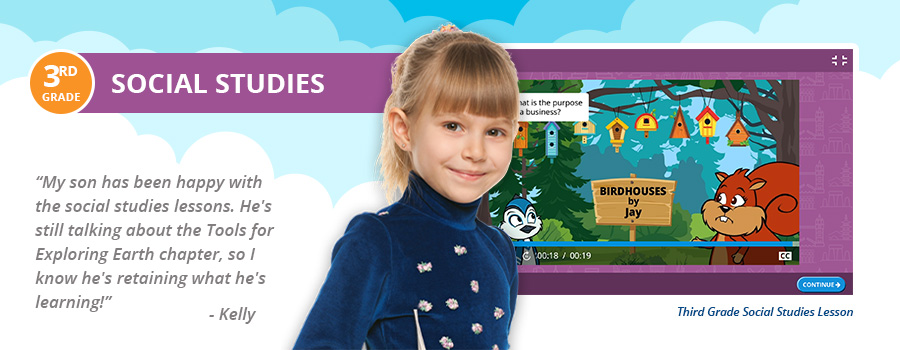
Social studies -3rd Grade Lesson Plans
Time4Learning is an online student-paced learning system covering preschool through middle school. It is popular as a third grade homeschool curriculum, for afterschool enrichment, for remediation, and for summer study.
The lesson plans below provide a detailed list of the third grade social studies curriculum, with brief activity descriptions and learning activity (LA) numbers. Additional resources related to third grade social studies are also provided, below.
Students enrolled in third grade social studies will have access to second grade social studies lessons as part of their membership. Fourth grade social studies is also available upon request, so they can move ahead or review at their own pace.
If you are just learning about Time4Learning, we'd suggest first looking at our interactive lesson demos. Members often use this page as a resource for more detailed planning, to choose specific activities using the activity finder or to compare our curriculum with state standards.
Non-Scored
|
Scored
|
Worksheet
|
Answer Key
|
Quiz
|
| Activities & Personalities: Describe the period known as the Viking Age, including dates, deeds, and exploration of the Atlantic Ocean. Explain the Scandanavian expression, ''to-go a-Viking,'' and name some notorious activities and personality characteristics attributed to the Vikings. Describe the Viking warrior, including his armor, weapons, battle strategies, and tactics. |
Raiders from the Sea |
 |
3764 |
|
| They Came from the North Country |
 |
3765 |
|
| Lesson Quiz: Activities & Personalities |
 |
|
|
| Shipbuilding: Explain the reasons the Vikings traveled by sea to other lands and the navigation methods used by the Vikings to determine directions and locations. Identify the kind of ship used for battle, and explain what made the ship sail at a fast speed. |
Seafarers and Shipbuilders |
 |
3766 |
|
| Builders and Sailors of the Longboats |
 |
3767 |
|
| Lesson Quiz: Shipbuilding |
 |
|
|
| Occupations: Describe the role and importance of shipbuilding in the lives of the Vikings. Compare and describe the occupations of the majority of Vikings with the Viking warriors. |
Travel, Work and Trade |
 |
3768 |
|
| The Good Ship Viking |
 |
3769 |
|
| Lesson Quiz: Occupations |
 |
|
|
| Culture: Describe the culture of the Vikings, including family life, food, clothing, literature, recreation, artistry, and burial customs. Explain the role of religion and the worship of the gods, Thor, and Frey. |
A Taste of Viking Life |
 |
3770 |
|
| How to Live Like a Viking |
 |
3771 |
|
| Lesson Quiz: Culture |
 |
|
|
| Chapter Test: Vikings: |
|
| Geography: Describe the region of the Alaskan Inuits, including land, climate, population, and environment. Estimate the number of years of habitation of the northwest coast or arctic homeland. |
Homeland of the 'Real People' |
 |
3772 |
  |
| Land of Ice and Snow |
 |
3773 |
|
| Lesson Quiz: Geography |
 |
|
|
| Land of the Midnight Sun: Explain why the region of Alaska is often called the ''Land of the Midnight Sun.'' |
The Land of the Midnight Sun |
 |
3774 |
|
| Winter Moon, Summer Sun |
 |
3775 |
|
| Lesson Quiz: Land of the Midnight Sun |
 |
|
|
| Language: Explain why the Inuits were once called Eskimos, and know the various meanings of the word Eskimo. Identify the language of the Inuits and how words were constructed. |
Inuit or Eskimo? |
 |
3776 |
|
| The Words to the Story of the Inuit |
 |
3777 |
|
| Lesson Quiz: Language |
 |
|
|
| Traditional way of life: Describe the traditional way of life for the Inuits. Include food, clothing, hunting and fishing, travel, recreation, and art. |
Living the Inuit Way |
 |
3778 |
|
| Inuit Traditions |
 |
3779 |
|
| Lesson Quiz: Traditional way of life |
 |
|
|
| Family & Group Life: Describe the family life and group life of the Inuits. Identify rules of conduct, how disputes were settled, how children were treated, and how future marriage partners were chosen. |
One for All and All for One |
 |
3780 |
|
| Family Life of the Inuit |
 |
3781 |
  |
| Lesson Quiz: Family & Group Life |
 |
|
|
| Shelter: Investigate and describe the various shelters in which the Inuits lived, including tents, sod houses, and snow houses. Identify how these shelters were constructed. |
Give Me Shelter |
 |
3782 |
|
| House and Home, Inuit Style |
 |
3783 |
|
| Lesson Quiz: Shelter |
 |
|
|
| Religous beliefs: Investigate the religious beliefs of the Inuits. |
What the Inuit Believe |
 |
3784 |
|
| The Spirits of the Inuit |
 |
3785 |
|
| Lesson Quiz: Religous beliefs |
 |
|
|
| Traditional vs. modern: Compare and contrast the traditional ways of the Inuits with their present ways of life. Include food, clothing, housing, employment, education, and values. |
That Was Then, This Is Now |
 |
3786 |
|
| Inuit Yesterday, Inuit Today |
 |
3787 |
|
| Lesson Quiz: Traditional vs. modern |
 |
|
|
| Chapter Test: Alaskan Inuits: |
|
| Geographic tools: Use geographic tools, such as maps, globes, and atlases, to gather data about the Earth's surface. Locate and name your community, state, country, and continent. Identify the major oceans: Pacific, Atlantic, Indian, Arctic and Antarctic. Identify the seven continents: Asia, Europe, Africa, North America, South America, Antarctica, and Australia. Identify the hemispheres: Northern, Southern, Western, and Eastern. |
Finding Funville! |
 |
33990 |
|
| Tools to Build Your Knowledge of Geography |
 |
3700 |
|
| Tools of the Trade |
 |
3701 |
  |
| Lesson Quiz: Geographic tools |
 |
|
|
| Geographic Terms: Demonstrate the ability to use the following geographic terms: harbor, island, bay, peninsula, gulf, ocean, coast, region, and mountain. Locate and label examples of each on a map, and write definitions of the terms. |
Geographic Terms |
 |
3704 |
|
| Isn't It All Just Land and Water? |
 |
3705 |
|
| Lesson Quiz: Geographic Terms |
 |
|
|
| Latitude & Longitude: Locate Alaska on a map and globe. Describe Alaska's position relative to the rest of the continental United States. Locate and label the Gulf of Alaska and the Bering Strait. |
Where Am I? |
 |
3706 |
|
| North to Alaska |
 |
3707 |
|
| Lesson Quiz: Latitude & Longitude |
 |
|
|
| Adaptation of Environment: Describe how climate, locations, and physical surroundings affect the ways people live in Alaska. |
Why People Live Where They Do |
 |
3708 |
|
| Who Wants to Live in Alaska? |
 |
3709 |
|
| Lesson Quiz: Adaptation of Environment |
 |
|
|
| Locate Rocky Mountains: Use a map to locate the Rocky Mountains from New Mexico through Canada to northern Alaska. |
Scales Aren't Just on a Fish |
 |
3710 |
|
| To the End of the Continent |
 |
3711 |
|
| Lesson Quiz: Locate Rocky Mountains |
 |
|
|
| Locate Scandinavia: Use a world map to locate the region of Europe that was once known as Scandanavia. Identify and label the three countries as they are now known (Denmark, Norway, and Sweden). |
So That's Where Reindeer Live |
 |
3712 |
|
| Scandinavia |
 |
3713 |
|
| Lesson Quiz: Locate Scandinavia |
 |
|
|
| Chapter Test: The World in Spatial Terms: |
|
| Reasons for Exploration: Identify several reasons that Europeans were willing to endure many hardships to explore and settle in new lands. Include the search for wealth, the desire to explore, the search for trade routes, new navigation methods, and religious missionary work. |
The World Is Bigger Than You Think |
 |
3714 |
|
| Lesson Quiz: Reasons for Exploration |
 |
|
|
| Columbus Journeys: Describe Christopher Columbus's first journey to America. Identify the names of his three ships, the land he had mistakenly named India, the name he gave native people, and the day of his landing. |
Off to Asia? America? |
 |
3716 |
  |
| Lesson Quiz: Columbus' Journeys |
 |
|
|
| Amerigo Vespucci: Explain whether or not Columbus learned after three additional voyages that he never reached India, but the New World. Identify the Italian trader and explorer who made the first voyage in 1499 to the New World for whom America was named. Identify the Spanish explorer who confirmed Vespucci's conclusion regarding this new land. |
If at First You Don't Succeed, Try, Try Again |
 |
3718 |
|
| Lesson Quiz: Amerigo Vespucci |
 |
|
|
| Columbus discoveries: Investigate how the voyages of Columbus reshaped America. Describe how these voyages exchanged plants, animals, and diseases between the Eastern and Western Hemispheres. Identify some of these plants, animals, and diseases. |
The World Was Changed Forever |
 |
3720 |
|
| Lesson Quiz: Columbus' discoveries |
 |
|
|
| Ponce de Leon: Describe Ponce de Leon's role in the settlement of Florida (including dates). Explain the legend of the ''Fountain of Youth'' (where Ponce de Leon learned of the legend, and whether Ponce de Leon found the Fountain of Youth). Identify who killed Ponce de Leon (and how). |
Searching for the Fountain of Youth |
 |
3722 |
|
| Lesson Quiz: Ponce de Leon |
 |
|
|
| Hernando De Soto: Describe the 1539 Spanish expedition led by Hernando de Soto to Florida. Include the battle with the Cherokee Indians and how de Soto was associated with the Mississippi River. Identify how de Soto died and where he was buried. |
Exploring up from Florida |
 |
3724 |
|
| Lesson Quiz: Hernando De Soto |
 |
|
|
| St. Augustine: Describe the founding of St. Augustine in 1565 and its heritage as the oldest city in the United States. |
America's Oldest City |
 |
3726 |
|
| Lesson Quiz: St. Augustine |
 |
|
|
| Northwest Passage: Describe the searches made by John Cabot and Henry Hudson for the Northwest Passage. Identify and locate the regions they found and the dates of their discoveries. Describe the hardships they encountered and the contributions they made to their countries. |
Happening up North? |
 |
3728 |
|
| Lesson Quiz: Northwest Passage |
 |
|
|
| French Explorers: Investigate the role Samuel de Champlain played in the region of New France. Identify, locate, and label the region Champlain discovered (Quebec). Identify, locate, and label the lakes Champlain explored and mapped (the western end of the St. Lawrence River, in northern New York). |
A Permanent French Settlement |
 |
3730 |
|
| Lesson Quiz: French Explorers |
 |
|
|
| Exploration of Southwest: Identify the early Spanish explorers in the lands that are now the states of Texas, New Mexico, Arizona, and California. Describe the contributions each of the explorers made. |
Early Spanish Explorers |
 |
3732 |
|
| Lesson Quiz: Exploration of Southwest |
 |
|
|
| Spanish Missions: Identify various U.S. missionary settlements (especially those in Texas and California). Explain why the Spanish government sent missionaries to the southwestern part of what is now the United States. Explain who Padre Junipero Serra was. Describe life in a mission. Include what services missions provided for Native Americans, and what leaders of missions expected in return from Native Americans. |
Missions |
 |
3734 |
|
| Lesson Quiz: Spanish Missions |
 |
|
|
| Seven Cities of Cibola: Explain why Francisco Vásquez de Coronado organized an expedition to the Southwest in 1540. Describe the legend of the ''Seven Cities of Cibola.'' Locate and label the areas: Grand Canyon and the Rio Grande. |
Seven Cities of Gold |
 |
3736 |
|
| Lesson Quiz: 'Seven Cities of Cibola' |
 |
|
|
| Conflicts with Pueblos: Identify the region in which the Pueblo lived, the associated tribes (Hopi and Zuni), and the crops grown by them. Explain the conflicts between the Pueblo and the Spaniards. |
Pueblo |
 |
3738 |
|
| Lesson Quiz: Conflicts with Pueblos |
 |
|
|
| Chapter Test: Exploration of the Americas: |
|
| Locate English Colonies: Define colony. Use a map to locate and label the thirteen English colonies. Differentiate each colony by region: New England Colonies, Middle Colonies, and Southern Colonies. |
Thirteen in All |
 |
3740 |
  |
| Lesson Quiz: Locate English Colonies |
 |
|
|
| Reasons for Colonization: Describe the two major changes, religion and economics, in England that caused the great interest in establishing the English colonies. |
Religion or Country? |
 |
3742 |
|
| Lesson Quiz: Reasons for Colonization |
 |
|
|
| Jamestown: Explain how the first colony originated in Jamestown, Virginia (in 1607), and the role John Smith played. Describe the period known as the ''Starving Time.'' Explain how land ownership and growth of tobacco crops were major reasons for the survival of the Jamestown economy. |
Virginia Settlements |
 |
3744 |
|
| Lesson Quiz: Jamestown |
 |
|
|
| Pocahontas: Retell the legend and history of Pocahontas and John Rolfe. Explain their roles in the clashes between Native Americans |
The Legend of Pocahontas |
 |
3746 |
|
| An Early American Heroine |
 |
3747 |
|
| Lesson Quiz: Pocahontas |
 |
|
|
| Puritans: Describe the beliefs held by Puritans. Explain why some Puritans were called Pilgrims, and why, in 1620, the Puritans left Europe for Massachusetts. |
Puritans or Pilgrims? |
 |
3750 |
|
| Back to Basics |
 |
3751 |
|
| Lesson Quiz: Puritans |
 |
|
|
| Reasons for Migration: Explain several reasons why European colonists moved to America. Include the search for good farmland, trade opportunities, and religious freedom. |
Finding Just the Right Place |
 |
3752 |
|
| More Reasons to Move |
 |
3753 |
|
| Lesson Quiz: Reasons for Migration |
 |
|
|
| King Philips War: Explain the 1637 conflicts between Puritans and Native Americans. Describe the reasons for King Philip's War (in 1675). |
Conflict between Old and New |
 |
3754 |
|
| Lesson Quiz: King Philip's War |
 |
|
|
| Founders of Colonies: Identify the founders and dates of the following colonies: the Carolinas, Georgia, New Jersey, Delaware, and New York. Explain why the purchase of Manhattan Island was the most profitable land purchase in history. |
So Many Different Colonies |
 |
3756 |
|
| Who, When, Where |
 |
3757 |
|
| Lesson Quiz: Founders of Colonies |
 |
|
|
| Enslavement of Africans: Explain slave trade in the Southern Colonies and its economic impact. Explain the differences between indentured servants, and slaves as property. Describe the voyage known as the Middle Passage and its conditions for captured Africans. |
Slavery in the Southern Colonies |
 |
3758 |
|
| Lesson Quiz: Enslavement of Africans |
 |
|
|
| Plymouth Colony: Describe the establishment of the Plymouth Colony by the Pilgrims Include discussion of: the importance of religious freedom, the voyage of the Mayflower, the 1620 Mayflower Compact, and the first Thanksgiving. Explain why the Plymouth Colony was taken over by the Massachusetts colony. |
Plymouth Colony |
 |
3760 |
|
| Lesson Quiz: Plymouth Colony |
 |
|
|
| Colonial Life: In general terms, describe colonial life in America. Include areas such as colonial economy, society, government, homes, churches, schools, transportation, communication, art, and science. |
Everyday Life in Colonial America |
 |
3762 |
|
| Colonial Life |
 |
3763 |
|
| Lesson Quiz: Colonial Life |
 |
|
|
| Chapter Test: North American Colonization: |
|
| Your Community: Identify your community as rural, urban, or suburban. Identify the general features of each of these communities as related to size, density, and grasslands. |
City, Suburbs, or Country? |
 |
3803 |
|
| Your Community |
 |
3802 |
|
| Lesson Quiz: Your Community |
 |
|
|
| Characteristics: Describe the characteristics of rural, urban, and suburban communities in terms of housing, community size, populations, jobs, culture, recreation, and transportation. |
Welcome to the City |
 |
34024 |
|
| Welcome to the Suburbs |
 |
34026 |
|
| Welcome to the Country |
 |
34027 |
|
| The Place for You |
 |
3805 |
|
| Life in the City, Suburbs, Country |
 |
3804 |
|
| Lesson Quiz: Characteristics |
 |
|
|
| Compare & Contrast: Compare and contrast these different types of communities in the United States. Locate each type of community on a U.S. map. |
Where Do You Live? |
 |
34025 |
|
| Lesson Quiz: Compare & Contrast |
 |
|
|
| Relationships: Describe the relationship between people and their environments in rural, urban, and suburban communities. |
North or South, Hot or Cold |
 |
3808 |
|
| Wherever You Go, It's There |
 |
3809 |
|
| Lesson Quiz: Relationships |
 |
|
|
| Land Forms & Bodies of Water: Describe the various landforms and bodies of water that may be found in rural, urban, and suburban communities. |
Land and Water |
 |
3810 |
|
| Landforms and Bodies of Water |
 |
3811 |
|
| Lesson Quiz: Land Forms & Bodies of Water |
 |
|
|
| Resources: Identify the natural resources in your community. Describe ways in which people can protect these resources. |
Resources, Naturally |
 |
3812 |
|
| Nature's Gifts |
 |
3813 |
|
| Lesson Quiz: Resources |
 |
|
|
| Development & Change: Describe how rural, urban, and suburban communities have developed and changed over time. |
Over Time |
 |
3814 |
|
| Time Line |
 |
3815 |
|
| Lesson Quiz: Development & Change |
 |
|
|
| Chapter Test: Rural, Suburban, Urban Region: |
|
| Earn, Save, & Spend Money: Explain why people earn, save, and spend money. |
Money, Money, Money, Money |
 |
3788 |
|
| It Makes the World Go Round |
 |
3789 |
|
| Lesson Quiz: Earn, Save, & Spend Money |
 |
|
|
| Interdependence: Describe how people in the United States are dependent upon other countries for goods (products). Explain the interdependence of people and products in your community. |
All for One and One for All |
 |
3790 |
|
| The Things Everyone Needs |
 |
3791 |
|
| Lesson Quiz: Interdependence |
 |
|
|
| Employers/Employees: Describe the differences between employer and employees and the responsibilities and duties of each. |
Team Work |
 |
3792 |
|
| It Really Works |
 |
3793 |
|
| Lesson Quiz: Employers/Employees |
 |
|
|
| Function of Banks: Explain the different ways people can use banks: to save and to borrow money. Explain why banks charge interest to the borrower. |
You Can Bank On It |
 |
3794 |
|
| Take It to the Bank |
 |
3795 |
|
| Lesson Quiz: Function of Banks |
 |
|
|
| Natural Resources: Name the natural resources and the goods produced in your local region. |
Some Things of Value |
 |
3796 |
|
| All Natural |
 |
3797 |
|
| Lesson Quiz: Natural Resources |
 |
|
|
| Imports/Exports: Distinguish between imports and exports. |
The Ins and Outs of Economics |
 |
3798 |
|
| Import In/Export Out |
 |
3799 |
|
| Lesson Quiz: Imports/Exports |
 |
|
|
| Production of Goods: Identify the various ways that goods are produced: agriculture, manufacturing, mining, and trade. |
It's Good(s) for You |
 |
3800 |
|
| The Producers |
 |
3801 |
|
| Lesson Quiz: Production of Goods |
 |
|
|
| Chapter Test: Economics: |
|
| Purpose of Government & Law: Explain why all communities and states have governments and laws. Identify some laws in your community. |
Safe at Home |
 |
3816 |
|
| Law and Order |
 |
3817 |
  |
| Lesson Quiz: Purpose of Government & Law |
 |
|
|
| Duties, Heads of Government: Name the heads of your local and state government. Describe how the responsibilities of a mayor and governor differ. Identify some of the responsibilities of local government. Describe what a city council does and how people can become members of a city council. |
Heads of State and City |
 |
3818 |
|
| Lead, Follow, or Get out of the Way |
 |
3819 |
|
| Lesson Quiz: Duties, Heads of Government |
 |
|
|
| Town Meetings: Explain what a town meeting is, what issues may be discussed, and how decisions are made. Identify some issues in your community that need to be addressed. |
Speak for Yourself |
 |
3820 |
|
| Your Opinion Counts |
 |
3821 |
|
| Lesson Quiz: Town Meetings |
 |
|
|
| Participation: Explain why it is important for people to take part in local government by voting. Describe ways in which you have participated in voting at home, in school, or within groups and organizations. |
Get Involved |
 |
3822 |
|
| Cast Your Vote |
 |
3823 |
|
| Lesson Quiz: Participation |
 |
|
|
| Community Leaders: Identify leaders who have made a difference in the development of your community. Describe the contributions they have made. |
In the Lead |
 |
3825 |
|
| Lesson Quiz: Community Leaders |
 |
|
|
| Chapter Test: Citizenship & Government: |
|
Scope & Sequence Copyright © CompassLearning, Inc. All rights reserved.
Lesson Activity Finder Tool
The lesson activity finder is one of the many helpful tools that Time4Learning offers its members. The activity finder is a shortcut that makes it easy for parents to preview lessons or find extra practice for their child.
Every lesson in the curriculum has a unique activity number, referred to in the lesson plans as an "LA Number." These numbers can be found on the table above or the lesson plans in the parent administration area.
The activity finder can be found in the lower left hand corner of the Student LaunchPad page. To use it, members simply log in to their child’s account, type the Learning Activity (LA) number of a lesson into the Activity Finder and click “Go” to open it.
For additional information, please visit our hints and help section, which gives more details about the activity finder.
Back to the top or sign up now
Additional Resources Related to Third Grade Social Studies
If you're interested in the third grade social studies lesson plans, you might also be interested in:
Lesson plans for other grade levels of social studies:
Other third grade subjects and topics:
Wondering how many lessons to have your child do each day? Our lesson planning worksheet can help you estimate.
Online Curriculum for Homeschool, Afterschool and Summer Use
Sign up for Time4Learning and gain access to a variety of educational materials, which will engage and challenge your child to succeed. Make Time4Learning a part of your children's homeschool resources.
I want to Learn More about Time4Learning's homeschool curriculum or how to use the program for afterschool enrichment.
|