Curriculum Uses
Curriculum Levels
Benefits
- Online Curriculum for
PreK to 8th Grades
- Access to 3 Grade Levels of Lessons
- 1,000+ Student-Paced Multimedia Activities
- Language Arts, Math, Science & Social Studies
- Interactive, Project-Based Activities
- Detailed Reporting for
Easy Record-Keeping
- Lesson Plans & Teaching Tools for Parents
- Lessons Correlated to State Standards
What Do Parents Say?
I LOVE Time4Learning! It holds the attention of my kids, plus I can keep track of their learning without hovering over their shoulders.
I'm so thankful for your program! My kids have so much fun with the activities that they don't even notice that they're learning!
I am really pleased with Time4Learning. It has made a world of difference in my son's academic performance in school!
|
Science -3rd Grade Lesson Plans
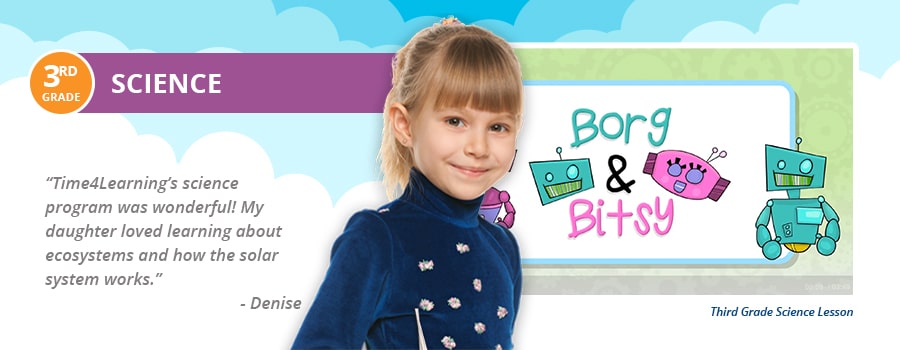
Time4Learning is an online student-paced learning system covering preschool through middle school. It is popular as a third grade homeschool curriculum, for afterschool enrichment, for remediation, and for summer study.
The lesson plans below provide a detailed list of the third grade science curriculum, with brief activity descriptions and learning activity (LA) numbers. Additional resources related to third grade science are also provided, below.
Students enrolled in third grade science will have access to second grade science lessons as part of their membership. Fourth grade science is also available upon request, so students can move ahead or review at their own pace.
If you are just learning about Time4Learning, we'd suggest first looking at our interactive lesson demos. Members often use this page as a resource for more detailed planning, to choose specific activities using the activity finder or to compare our curriculum with state standards.
Non-Scored
|
Scored
|
Worksheet
|
Answer Key
|
Quiz
|
| Use of Instruments: Identify various instruments used to collect and analyze data. |
Identifying Instruments |
 |
3624 |
|
| Scientific Instruments for Investigation |
 |
3625 |
|
| Lesson Quiz: Use of Instruments |
 |
|
|
| Working Collaboratively: Describe benefits and challenges of working collaboratively. Recognize that teammates should be free to reach, explain, and justify their individual conclusions. |
Working with a Partner |
 |
3626 |
|
| Working Together |
 |
3627 |
|
| Lesson Quiz: Working Collaboratively |
 |
|
|
| Comparing & Contrasting: Identify and use the essential science skills of comparing and contrasting when making observations. |
Making Observations and Comparisons |
 |
3628 |
|
| Compare and Contrast All You Observe |
 |
3629 |
|
| Lesson Quiz: Comparing & Contrasting |
 |
|
|
| Show Scientific Ideas: Use sketches, diagrams, and models to represent scientific ideas. |
Diagrams, Sketches, and Models |
 |
3630 |
|
| Science Models |
 |
3631 |
|
| Lesson Quiz: Show Scientific Ideas |
 |
|
|
| Predictions & Inferences: Make predictions and inferences based on observations. |
Inferences and Predictions |
 |
3632 |
|
| Making Inferences and Accurate Predictions |
 |
3633 |
|
| Lesson Quiz: Predictions & Inferences |
 |
|
|
| Use of Tables & Graphs: Use tables and graphs to identify patterns of change. |
Tables and Graphs |
 |
3634 |
|
| Identify Patterns of Change |
 |
3635 |
|
| Lesson Quiz: Use of Tables & Graphs |
 |
|
|
| Scientific Contributions: Use reference materials to obtain information about the contributions of Alexander Graham Bell (sound), Copernicus (astronomy), Mae Jemison (exploration of space), and John Muir (ecology). |
Using Reference Materials |
 |
3636 |
  |
| Gathering Background Information |
 |
3637 |
|
| Lesson Quiz: Scientific Contributions |
 |
|
|
| Explaining Concepts: Conclude that events or concepts can be explained by collecting, organizing, and interpreting data. |
Collecting, Organizing and Interpreting Data |
 |
3638 |
|
| Data Investigation |
 |
3639 |
|
| Lesson Quiz: Explaining Concepts |
 |
|
|
| Scientific Discoveries: Identify specific scientific discoveries that have helped or hindered scientific progress in understanding human health and the environment. |
Science News |
 |
3642 |
|
| Wild Discoveries |
 |
3643 |
|
| Lesson Quiz: Scientific Discoveries |
 |
|
|
| Scientific Processes: Describe how the use of scientific knowledge can help people solve problems, make decisions, and form new ideas. |
Puzzling Problems |
 |
3644 |
|
| Problem Solvers |
 |
3645 |
|
| Lesson Quiz: Scientific Processes |
 |
|
|
| Chapter Test: Scientific Investigation: |
|
| Physical Properties: Determine the physical properties of matter using customary and metric measurements that incorporate tools such as rulers, thermometers, and balances. |
Measure Up! |
 |
3540 |
|
| For Good Measure |
 |
3541 |
|
| Lesson Quiz: Physical Properties |
 |
|
|
| Physical Changes: Identify matter as liquids, solids, and gases. Identify and describe examples of physical changes in the states of matter produced by heating and cooling. |
Ice, Water, Steam |
 |
3542 |
|
| What Is Matter? |
 |
3543 |
|
| Lesson Quiz: Physical Changes |
 |
|
|
| Weight: Investigate and realize that the weight of an object is equal to the sum of the weights of its parts. |
Matter and Weight |
 |
3544 |
|
| Investigating Weight |
 |
3545 |
|
| Lesson Quiz: Weight |
 |
|
|
| Observation: Use hand lenses to observe and document minute physical properties of objects. |
Through the Looking Glass |
 |
3546 |
|
| Look Closely |
 |
3547 |
|
| Lesson Quiz: Observation |
 |
|
|
| Chapter Test: Nature of Matter: |
|
| Heat & Light Objects: Identify objects that emit heat and light. |
Heat and Light |
 |
3648 |
|
| Turn On the Heat! |
 |
3649 |
|
| Lesson Quiz: Heat & Light Objects |
 |
|
|
| Forms of Energy: Identify different forms of energy, such as heat, light, and sound. |
Different Forms of Energy |
 |
3650 |
|
| Earth's Neighbors |
 |
3609 |
|
| Energy Makers |
 |
3651 |
|
| Lesson Quiz: Forms of Energy |
 |
|
|
| Role of Sun: Demonstrate an understanding that the Sun provides energy for Earth in the form of heat and light. |
Forms of Solar Energy |
 |
3652 |
|
| Solar Energy |
 |
3653 |
|
| Lesson Quiz: Role of Sun |
 |
|
|
| Sources of Heat: Demonstrate understanding that heat can be produced by chemical reactions, electrical machines, and friction. |
Heat Producers |
 |
3654 |
|
| Understanding Heat |
 |
3655 |
|
| Lesson Quiz: Sources of Heat |
 |
|
|
| Measuring Energy: Identify and use a variety of tools to measure the gain or loss of energy. |
When You're Hot, You're Hot |
 |
3656 |
|
| Lesson Quiz: Measuring Energy |
 |
|
|
| Heat Transference: Demonstrate understanding that when a warmer object comes in contact with a cooler one, the warm object loses heat and the cool one gains it (until they are both the same temperature). |
Hot and Cold |
 |
3658 |
|
| Cold and Hot |
 |
3659 |
|
| Lesson Quiz: Heat Transference |
 |
|
|
| Energy for Life: Demonstrate understanding that some source of energy is needed for organisms to stay alive and grow. |
Food for Thought |
 |
3661 |
|
| Lesson Quiz: Energy for Life |
 |
|
|
| Natural Resources: Identify natural resources and their importance. |
Natural Resources |
 |
3662 |
|
| Naturally Made |
 |
3663 |
|
| Lesson Quiz: Natural Resources |
 |
|
|
| Renewable/Nonrenewable: Classify resources as renewable or nonrenewable. Describe uses for renewable and nonrenewable resources. |
Resourceful |
 |
3664 |
|
| Resources and You |
 |
3665 |
|
| Lesson Quiz: Renewable/Nonrenewable |
 |
|
|
| Effects on Environment: Identify ways that using natural resources for producing energy affects the environment. |
Energy Resource |
 |
3666 |
|
| Power for the People |
 |
3667 |
|
| Lesson Quiz: Effects on Environment |
 |
|
|
| Energy Causes Motion: Describe how energy is necessary to create a force that can cause motion. |
Be Forceful! |
 |
3668 |
|
| Don't Force It! |
 |
3669 |
|
| Lesson Quiz: Energy Causes Motion |
 |
|
|
| Motion of Objects: Describe the motion of various objects, including forward, circular, and wave motions. |
Force and Motion |
 |
3670 |
|
| Motion of Objects |
 |
3671 |
|
| Lesson Quiz: Motion of Objects |
 |
|
|
| Elements of Waves: Identify the characteristics of waves, including crest, trough, and length. |
Waves in Motion |
 |
3672 |
|
| Characteristics of Waves |
 |
3673 |
|
| Lesson Quiz: Elements of Waves |
 |
|
|
| Simple Machines: Identify these six types of simple machines: screw; inclined plane; wedge; pulley; lever; wheel and axle. |
Simple Machines = Simple Work |
 |
3674 |
|
| Lesson Quiz: Simple Machines |
 |
|
|
| Force Causes: Demonstrate understanding that force causes change. |
Changes |
 |
3676 |
|
| Forceful |
 |
3677 |
|
| Lesson Quiz: Force Causes |
 |
|
|
| Position/Direction of Objects: Measure and record changes in the position and direction of the motion of an object on which force (such as a push or pull) has been applied. |
Sock Hop |
 |
3679 |
|
| Lesson Quiz: Position/Direction of Objects |
 |
|
|
| Chapter Test: Energy, Force and Motion: |
|
| Factors of Surface Changes: Demonstrate understanding that the surface of Earth can be changed by forces such as earthquakes, glaciers, and volcanoes. |
Forces that Change Landforms |
 |
34003 |
|
| The Changing Planet |
 |
3548 |
  |
| Focus of Change |
 |
3549 |
|
| Lesson Quiz: Factors of Surface Changes |
 |
|
|
| Origins of Small Rocks: Demonstrate understanding that smaller rocks come from the breaking and weathering of bedrock and larger rocks. |
Rocks and Sand |
 |
3550 |
|
| Sand and Rocks |
 |
3551 |
|
| Lesson Quiz: Origins of Small Rocks |
 |
|
|
| Amount of Water: Demonstrate understanding that about 75 percent of Earth's surface is covered by water, and describe the stages of the water cycle. |
Thirsty Anyone? |
 |
3552 |
|
| Water Wise |
 |
3553 |
|
| Lesson Quiz: Amount of Water |
 |
|
|
| Weathering & Erosion: Identify and describe characteristics of the process of weathering and erosion, such as weathering of landforms and erosion of soil. |
Weathering Heights |
 |
34012 |
|
| Erosion |
 |
34002 |
|
| Changing Earth's Surface |
 |
3555 |
|
| Weathering and Erosion |
 |
3554 |
|
| Lesson Quiz: Weathering & Erosion |
 |
|
|
| Recycling: Identify and describe reusing, recycling, and reducing and how these processes improve and protect the condition of Earth. |
Recycling Rules |
 |
34011 |
|
| One Planet |
 |
3557 |
|
| Closing the Loop |
 |
3556 |
|
| Lesson Quiz: Recycling |
 |
|
|
| Chapter Test: Effects on the Shape of Earth: |
|
| Habitats: Identify habitats and the relationships among organisms and their environment. |
Where Is My Home? |
 |
3558 |
  |
| Habitats |
 |
3559 |
|
| Lesson Quiz: Habitats |
 |
|
|
| Balance of Nature: Describe the concept of the balance of nature, and know that nature is constantly changing. |
Balance of Nature |
 |
3560 |
|
| Balancing Act |
 |
3561 |
|
| Lesson Quiz: Balance of Nature |
 |
|
|
| Food Chain: Identify and describe the food chain: producers, consumers, and decomposers. |
Food Chain |
 |
3562 |
|
| Team Players |
 |
3563 |
|
| Lesson Quiz: Food Chain |
 |
|
|
| Effects on Ecosystems: Identify the concept of an ecosystem and how ecosystems can be affected by changes in environment such as precipitation, food supply, and changes caused by humans. |
Ecosystems |
 |
3564 |
|
| Living Environments |
 |
3565 |
|
| Lesson Quiz: Effects on Ecosystems |
 |
|
|
| Environmental Threats: Identify and describe man-made threats to the Environment (such as air and water pollution caused by emissions, smog, industrial waste, and chemical run-off). |
Pollution |
 |
3566 |
|
| Man and the Environment |
 |
3567 |
|
| Lesson Quiz: Environmental Threats |
 |
|
|
| Environmental Protection: Describe measures people can take to protect the environment. |
Protecting the Environment |
 |
3568 |
|
| Keep It Clean |
 |
3569 |
|
| Lesson Quiz: Environmental Protection |
 |
|
|
| Extinction: The learner will understand that some kinds of organisms that once lived on earth have completely disappeared. |
Extinction Blues |
 |
34014 |
|
| Lesson Quiz: Extinction |
 |
|
|
| Chapter Test: Ecology: |
|
| Animal & Plant Link: Describe the various ways that animals depend on plants for survival (including food, shelter, and oxygen). |
Magic 8-Ball |
 |
34013 |
|
| If You Plant It, They Will Come |
 |
3571 |
|
| Plants Are Our Friends |
 |
3570 |
|
| Lesson Quiz: Animal & Plant Link |
 |
|
|
| Modifying the Environment: Describe how living organisms (for example, beavers and birds) modify their physical environment to meet their needs. |
Housekeeping |
 |
3572 |
|
| Behaviors |
 |
3573 |
|
| Lesson Quiz: Modifying the Environment |
 |
|
|
| React to Changing Environment: Understand that when the environment changes, some plants and animals survive and reproduce, and others die or move to new locations. |
Frozen Room Theory |
 |
34033 |
|
| Lesson Quiz: React to Changing Environment |
 |
|
|
| Extinction: Identify organisms that once lived on earth, and have completely disappeared. |
Extinction Blues |
 |
34034 |
|
| Lesson Quiz: Extinction |
 |
|
|
| Vertebrate Animals: Identify the distinguishing characteristics of vertebrate animals (mammals, birds, fish, reptiles, and amphibians). |
Show Some Backbone |
 |
33999 |
|
| Backbones |
 |
3575 |
|
| Do You Have a Backbone? |
 |
3680 |
|
| Vertebrates |
 |
3574 |
|
| Lesson Quiz: Vertebrate Animals |
 |
|
|
| Invertebrate Animals: Identify the distinguishing characteristics of invertebrate animals: flatworms, centipedes, sun jellyfish, black widow spiders, and octopuses. |
Animals without Backbones |
 |
3576 |
|
| Invertebrates |
 |
3577 |
|
| Lesson Quiz: Invertebrate Animals |
 |
|
|
| Comparing Plants: Identify similarities and differences among plants. |
The World of Plants |
 |
3578 |
|
| Plants |
 |
3579 |
|
| Lesson Quiz: Comparing Plants |
|
|
|
| Compare Plants & Animals: Identify similarities and differences between plants and animals. (Similarities include: both plants and animals have structures for reproduction, respiration, and growth.) |
Plantanimals |
 |
3580 |
|
| Plants Versus Animals |
 |
3581 |
|
| Lesson Quiz: Compare Plants & Animals |
 |
|
|
| Organism Competition: Identify ways that organisms with similar needs compete with one another for resources (such as oxygen, water, food, and space). |
Competition |
 |
3582 |
|
| Resources |
 |
3583 |
|
| Lesson Quiz: Organism Competition |
 |
|
|
| Organisms & Animals Adapt: Identify behavioral and structural adaptations that allow plants and animals to survive in an environment. |
Prepare to Adapt |
 |
3584 |
|
| Fitting In |
 |
3585 |
|
| Adaptations |
 |
34035 |
|
| Changing with the Season |
 |
34038 |
|
| Lesson Quiz: Organisms & Animals Adapt |
 |
|
|
| Classifying Organisms: Demonstrate understanding that living organisms get energy from the food they eat and that living things are classified as producers, consumers, carnivores, herbivores, and omnivores. |
Producers and Consumers |
 |
3586 |
|
| Energize! |
 |
3587 |
|
| Lesson Quiz: Classifying Organisms |
 |
|
|
| Population Constraints: Demonstrate understanding that the size of a population is dependent upon the available resources. |
Population Size |
 |
3588 |
|
| Population |
 |
3589 |
|
| Lesson Quiz: Population Constraints |
 |
|
|
| Chapter Test: Life/Environment Interact: |
|
| Travel of Light: Demonstrate understanding that light travels in straight lines at extremely high speeds (and forms shadows). |
Light Speed |
 |
3590 |
|
| High Speed Light |
 |
3591 |
|
| Lesson Quiz: Travel of Light |
 |
|
|
| Uses for Lenses: Identify and describe uses for lenses. (These include: magnification, microscopes, cameras, and telescopes). |
Lenses |
 |
3598 |
|
| Magnify Me! |
 |
3599 |
|
| Lesson Quiz: Uses for Lenses |
 |
|
|
| Characteristics of Sound: Identify the characteristics of sound. (Some characteristics include: an object vibrating rapidly causes sound; sound travels through solids, liquids, and gases; sound travels much slower than light). |
Sound Wave |
 |
3600 |
|
| Traveling Sound |
 |
3601 |
|
| Lesson Quiz: Characteristics of Sound |
 |
|
|
| Qualities of Pitch: Identify and describe the qualities of pitch (high or low) and intensity (loudness and softness). |
Behavior of Sound Waves |
 |
3602 |
|
| Sound Movement |
 |
3603 |
|
| Lesson Quiz: Qualities of Pitch |
 |
|
|
| Human Voice & Hearing: Demonstrate understanding about hearing (how the ear works), and how to protect your hearing. Demonstrate understanding about the human voice. (The larynx has vibrating vocal cords. Longer, thicker cords create lower, deeper voices). |
Speech and Hearing |
 |
3604 |
  |
| Lesson Quiz: Human Voice & Hearing |
 |
|
|
| Chapter Test: Light & Sound: |
|
| Universe & Galaxies: Identify and describe the universe and galaxies, including the Milky Way and Andromeda. |
The Whole Universe |
 |
3606 |
  |
| Expanding Universe |
 |
3607 |
|
| Lesson Quiz: Universe & Galaxies |
 |
|
|
| Effects of Planetary Motions: Identify the planetary motions of rotating and revolving and their effects on Earth, including the causes of day, night, and the seasons. Also identify where the sun rises (east) and sets (west), that days and nights change in length throughout the year, and the effect of the earth's tilted axis on the seasons. |
Planetary Motion |
 |
3610 |
|
| Keep on Spinning |
 |
34032 |
|
| Lesson Quiz: Effects of Planetary Motions |
 |
|
|
| Gravitational Effects: Demonstrate an understanding of the gravitational effect of the Moon (and to a lesser degree, the Sun) on the Earth's tides. |
Tidal Zone |
 |
3612 |
|
| Lesson Quiz: Gravitational Effects |
 |
|
|
| Asteroid, Meteor, Comet: Identify characteristics of asteroids, meteoroids, and comets (include Haley's comet). |
Space Stuff |
 |
3616 |
  |
| Meteors, Asteroids, and Comets |
 |
3617 |
|
| Lesson Quiz: Asteroid, Meteor, Comet |
 |
|
|
| Solar Eclipse: Describe the cause of a solar eclipse. |
Solar Eclipse |
 |
3618 |
|
| Solar Shadows |
 |
3619 |
  |
| Lesson Quiz: Solar Eclipse |
 |
|
|
| Space Exploration: Investigate and record data about space exploration that includes telescopes, rockets, satellites, the first moon landing, by Apollo 11, and the space shuttles. |
Space Exploration |
 |
3622 |
|
| Exploration Investigation |
 |
3623 |
|
| Lesson Quiz: Space Exploration |
 |
|
|
| Chapter Test: Astronomy: |
|
Scope & Sequence Copyright © CompassLearning, Inc. All rights reserved.
Lesson Activity Finder Tool
The lesson activity finder is one of the many helpful tools that Time4Learning offers its members. The activity finder is a shortcut that makes it easy for parents to preview lessons or find extra practice for their child.
Every lesson in the curriculum has a unique activity number, referred to in the lesson plans as an "LA Number." These numbers can be found on the table above or the lesson plans in the parent administration area.
The activity finder can be found in the lower left hand corner of the Student LaunchPad page. To use it, members simply log in to their child’s account, type the Learning Activity (LA) number of a lesson into the Activity Finder and click “Go” to open it.
For additional information, please visit our hints and help section, which gives more details about the activity finder.
Back to the top or sign up now
Additional Resources Related to Third Grade Science
If you're interested in the third grade science lesson plans, you might also be interested in:
Lesson plans for other grade levels of science:
Other third grade subjects and topics:
Wondering how many lessons to have your child do each day? Our lesson planning worksheet can help you estimate.
Online Curriculum for Homeschool, Afterschool and Summer Use
Sign up for Time4Learning and gain access to a variety of educational materials, which will engage and challenge your child to succeed. Make Time4Learning a part of your children's homeschool resources.
I want to Learn More about Time4Learning's homeschool curriculum or how to use the program for afterschool enrichment.
|