Fifth Grade Homeschool Language Arts Curriculum
Fifth grade language arts continues to build on the language, vocabulary, writing and reading comprehension skills that students have been learning throughout elementary school. This year, students will learn grade-appropriate vocabulary and expand their knowledge on topics like synonyms, antonyms, prefixes and suffixes, just to name a few. In addition, they will learn a number of grammar skills including the correct use of perfect verb tenses, correlative conjunctions, transitions, and more.
What Language Arts Concepts Should a Fifth Grader Know?
This year, students will be learning new language arts skills as well as building their knowledge and mastery on previously learned concepts. In order to do that, students should be comfortable reading and answering questions on a wide variety of texts in a number of different themes and topics. In addition, their writing skills should allow them to create concrete ideas complete with supporting details.
Typically, fifth grade language arts students should be able to:
- Use pronouns in subjective and objective case
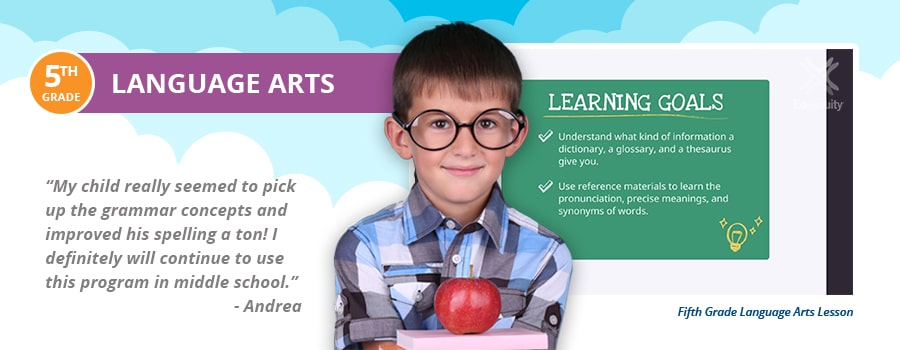
- Use reference material such as dictionaries, glossaries, and thesauruses
- Apply knowledge and information from texts to make inferences
- Decode words using prefixes and suffixes
- Identify and summarize the theme/main idea of a story
Discover everything that is included in Time4Learning’s fifth grade language arts scope and sequence below.
Fifth Grade Reading Goals/Objectives
In fifth grade, students read a mix of literary and informational texts to strengthen their reading fluency and comprehension skills as well as expand their vocabulary.
Below are just some of the reading goals that fifth grade language arts activities should help your child achieve.
- Summarize and paraphrase information from a text
- Read and interpret charts, graphs and other graphic representations in a text
- Analyze a writer’s point of view and compare points of view from various writers on the same topic
Learn more about Time4Learning’s reading curriculum and how it helps your child achieve their academic goals.
Fifth Grade Writing Goals/Objectives
Writing skills will continue to be polished and built upon this year. A fifth grade language arts curriculum will help students learn and master tons of new writing concepts including the following:
- Use interjections, prepositions and conjunctions for more descriptive and elaborate writing
- Understand each of the five stages of the writing process: planning, drafting, revising, editing, publishing
- Write a narrative complete with an event, narrator and characters
Fifth Grade Grammar Goals/Objectives
Fifth grade language arts activities should provide students with plenty of opportunities to learn and practice new grammar skills in order to enhance their writing and communication. Below are some of the grammar goals and objectives that a fifth grade language arts curriculum should help your child achieve.
- Use punctuation in titles correctly with proper capitalization, quotation marks, underscore, and italics
- Use correlative conjunctions correctly in a sentence: not only/but also, either/or, neither/nor
- Use perfect verb tense correctly and understand how they convey time of events
Learn more about the importance of grammar and the grammar skills your child will learn throughout the years with an effective homeschool grammar curriculum.
Time4Learning’s Language Arts Lessons
The student will demonstrate knowledge by determining the meaning of synonyms from grade level appropriate vocabulary, by correctly choosing a given word or phrase that means the same thing.
The student will demonstrate knowledge by determining the meaning of antonyms from grade level appropriate vocabulary, by correctly choosing a given word or phrase that means the opposite.
The student will be able to analyze and determine the correct meaning of a word, based on the prefix of the root word or how the prefix is used in the context of a passage.
The student will be able to analyze and determine the correct meaning of a word, based on the suffix of the root word or how the suffix is used in the context of a passage.
The student will be able to identify and select the appropriate homophone or word that sounds the same, based on the context of a passage which fits the best meaning of the given word or phrase.
The student will be able to identify and analyze the author’s use of idioms, based on the context of a passage and how these expressions are used in literal and interpretative information.
The student will be able to identify and determine the meaning of unknown words, based on the understanding of Latin and Greek roots.
Use the reading comprehension process skills of summarizing, predicting, visualizing, questioning, and clarifying with extensive scaffolding and support, through think aloud prompts.
Use the reading comprehension process skills of summarizing, predicting, visualizing, questioning, and clarifying with scaffolding and support, through think aloud prompts.
Use the reading comprehension process skills of summarizing, predicting, visualizing, questioning, and clarifying to independently read and comprehend texts with minimal think aloud support.
Use knowledge, information, and ideas from literary or expository texts to make inferences about the text (e.g., make inferences, draw conclusions, make generalizations, and infer sequence of events.)
Make a summary or paraphrase information from literary or expository text.
Identify the main idea(s) or theme(s), distinguishing them/it from supporting details in a literary text.
Identify plot by using story elements including the main problem and solution.
Identify the main idea(s) using the supporting details in an expository text.
Students will understand two different text structures: chronological order and cause and effect. They will apply these skills by comparing and contrasting two authentic nonfiction articles.
Students will understand two different text structures: chronological order and cause and effect. They will apply these skills by comparing and contrasting two authentic nonfiction articles.
Read, interpret and make predictions using charts, graphs, diagrams, maps or other graphic representations.
Compare and contrast characters, settings, ideas, information and/or plot within a text or between two or more genre sources (literary or expository), including figurative language such as metaphors.
Students will be introduced to academic words to increase language proficiency and activate background knowledge before analyzing two authentic nonfiction articles.
Students will be introduced to academic words to increase language proficiency and activate background knowledge before analyzing two authentic nonfiction articles.
Students will explore the meaning of five different proverbs to increase language proficiency before analyzing two authentic nonfiction articles.
Identify and use knowledge of the author’s purpose to comprehend the writing of a literary or expository text.
Students will understand the basic steps one must take when organizing notes from two sources. Students will independently read two nonfiction articles.
Students will review the basic steps to take when organizing notes from two sources. They will independently read two nonfiction articles.
Students will review the basic steps for taking notes and organizing notes from two sources. They will independently read two nonfiction articles.
Distinguish between fact and opinion in an expository text or within news sources, including the use of hyperbole.
Identify and distinguish between cause and effect in expository and literary texts.
Students will demonstrate knowledge of comprehension skills on grade level appropriate literary and expository passages, with questions that simulate a high-stakes assessment.
The student will explore content through discovery and develop vocabulary through the use of a literature-based glossary.
The student will achieve comprehension by reading literature with emphasis on vocabulary and respond to the literature. Authentic nonfiction literature is included.
The student will achieve comprehension by reading literature with emphasis on vocabulary and respond to the literature. Authentic nonfiction literature is included.
Through learning activities focused on recognition and application, the student will practice language art skills. These activities have direct instruction, practice, and scored assessment.
The student will explore content through discovery and develop vocabulary through the use of a literature-based glossary.
The student will achieve comprehension by reading literature with emphasis on vocabulary and respond to the literature. Authentic fiction literature is included.
The student will use a variety of strategies to comprehend reading selections. Student uses prior knowledge and will analyze and evaluate to make sense of texts.
Through learning activities focused on recognition and application, the student will practice language art skills. These activities have direct instruction, practice, and scored assessment.
The student will explore content through discovery and develop vocabulary through the use of a literature-based glossary.
The student will achieve comprehension by reading literature with emphasis on vocabulary and respond to the literature. Authentic fiction literature is included.
The student will use a variety of strategies to comprehend reading selections. Student uses prior knowledge and will analyze and evaluate to make sense of texts.
Through learning activities focused on recognition and application, the student will practice language art skills. These activities have direct instruction, practice, and scored assessment.
The student will explore content through discovery and develop vocabulary through the use of a literature-based glossary.
Through a series of learning activities focused on discovery, recognition, and application, the student will practice language arts skills.
The student will use a variety of strategies to comprehend reading selections. Student uses prior knowledge and will analyze and evaluate to make sense of texts.
Through learning activities focused on recognition and application, the student will practice language art skills. These activities have direct instruction, practice, and scored assessment.
The student will explore content through discovery and develop vocabulary through the use of a literature-based glossary.
The student will achieve comprehension by reading literature with emphasis on vocabulary and respond to the literature. Authentic fiction literature is included.
The student will use a variety of strategies to comprehend reading selections. Student uses prior knowledge and will analyze and evaluate to make sense of texts.
Through learning activities focused on recognition and application, the student will practice language art skills.
Fifth Grade Language Arts Extensions
Use text organizers, such as type, headings, and graphics, to predict and categorize information in informational texts.
Use context clues to determine the meaning of unfamiliar words.
Use text elements, such as time sequences, for understanding materials.
Retell main points to demonstrate interpretation of challenging texts.
Summarize and paraphrase written materials.
Identify the meaning of affixes.
Set purposes for reading.
Write about what is read.
Use internal punctuation to separate word groups.
Use commas after: yes, no, well, direct address, last name written first.
Use quotation marks in dialogue, in names of poems, songs, short stories, magazine articles, and essays.
Identify present, past, and future tenses of verbs.
Identify and use the past and past-participle forms of irregular verbs.
Identify direct and indirect objects.
Identify and use predicate adjectives.
Identify and use the adjective suffixes: -able, -ful, -less, -y.
Identify and use comparative and superlative forms of adverbs.
Describe the defining characteristics of suspense. Read suspense stories.
Describe the defining characteristics of historical fiction. Read historical fiction stories.
Describe the defining characteristics of traditional tales. Read traditional tales.
Compare fables and stories from two or more cultures or time periods.
Describe the development of plot, and explain how conflicts are resolved.
Describe the characteristics of free verse, rhymed, and patterned poetry.
Describe character development in fiction and poetry selections.
Write a complete paragraph by using a topic sentence and supporting sentences.
Write letters formatted for a specific purpose.
Write an outline, organizing information by main ideas and supporting ideas.
Write a research report and cite reference sources.
Write narratives with common story elements, such as plot, character, theme and setting.
Write compositions including both literal and figurative language.
Apply knowledge of revision strategies, such as combining sentences, substituting words, and expanding ideas.
Distinguish between first- and third-person point of view.
Perform oral readings of prose and poetry.
Demonstrate use of oral language effectively by control of eye contact, speaking rate, volume, and enunciation.
Use spoken language concisely and creatively, depending on the purpose of communication.
Express opinions respectfully.
Listen to, identify, and then summarize main ideas of a speech or lecture.
Give, listen to, and follow directions.
Scope & Sequence Copyright © 2024 Edgenuity, Inc. All rights reserved.
Why Choose Time4Learning Fifth Grade Language Homeschool Curriculum
Learning grammar, writing, comprehension and vocabulary skills are a crucial part of a 5th grade education. It’s important that students build on what they already know and learn more advanced concepts as they complete their elementary education and head into middle school.
The Time4Learning fifth grade language arts curriculum offers students a comprehensive education that correlates to all state standards. Our award-winning, online curriculum makes learning all the necessary language arts skills fun thanks to interactive and engaging activities and lessons. Learn more about our online fifth grade curriculum, designed to help your child learn and master their fundamental concepts.