Vocabulary Development
Vocabulary refers to the collection of words that a person knows and uses. Vocabulary development is the process of acquiring new words. The size of a child’s vocabulary between preschool and first grade is often a strong indicator of their reading comprehension in later grades. That’s why it’s so important to focus on building vocabulary skills throughout reading instruction.
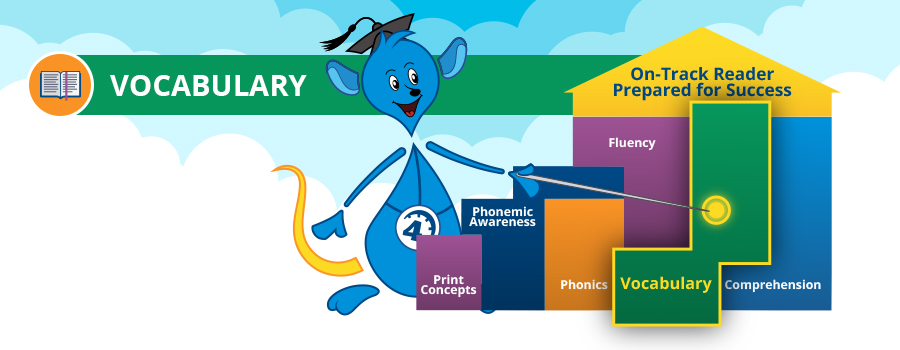
The Reading Skills Pyramid is a visual depiction of the process that children go through when learning to read. It recognizes that there are usually 5 steps to learning to read:
- Connecting sounds to letters (phonemic awareness)
- Distinguishing between letter sounds (phonics)
- Understanding and interpreting what one is reading (reading comprehension)
- Building on the words they do know to learn new words (vocabulary)
- Starting to read easily and with fewer delays (fluency)
On this page we will explore the importance of vocabulary development and how it lays the groundwork for comprehension and fluency.
Learning New Words
Building vocabulary is a complex process. In order to successfully build vocabulary skills, there are multiple components of gaining mastery over new words.
- The first component of learning new words is exposure: seeing the new word enough times to grow familiar with it.
- The second component is understanding the definition of the word, as well as how it is commonly used in context.
- Another component of vocabulary building is recognizing synonyms of the word.
- Examples of how the word is used in context can be a helpful component of learning vocabulary as well.
- Finally, students should have plenty of opportunity to practice using the new word, both orally and in print.
Without a doubt, the best way to help your child learn new words is to read to them as often as possible. Reading aloud is even more effective when you take the time to stop and explain the meaning of any unfamiliar words as you go. Other fun vocabulary activities you can do with your child include:
- Playing guessing games (e.g. “I’m thinking of a word that starts with ‘tr.’ Can you guess it?”)
- Posting a “word of the day” somewhere prominent in your house and seeing how many times each person can use the word that day
- Taking a “letter walk” to see how many things you can spot that start with a specific letter
- Playing vocabulary bingo, using both familiar and unfamiliar words for the squares
- Taking turns telling each other riddles
- Playing charades with words and phrases that are on your child’s learning level
Building Vocabulary Skills with Time4Learning
Many students face the same problem: they just don’t know that many words. Because the computer is usually one of a child’s favorite activities, an online reading program that integrates vocabulary activities into the curriculum can be an effective method to increase vocabulary.
There are many ways to improve and increase vocabulary skills. With Time4Learning, building vocabulary skills is fun and easy! It uses exciting, multimedia activities to teach standards-based reading & vocabulary lessons as part of a language arts curriculum.
Some of the ways Time4Learning highlights vocabulary instruction include:
- Multiple exposures to new and unfamiliar words
- Teaches roots to help students understand words that use the same root
- Aims at teaching at least X new words in every lesson.
- Printable vocabulary worksheets to reinforce memorizing new words
- Vocabulary quizzes after X chapters/lessons to cement new words in child’s memory.
These kind of focused vocabulary lessons not only help early readers learn new words but also pave the way for students to comprehend more of what they are reading as well.